
Ever since the beginning of its armed struggle against Moscow during World War II, the Ukrainian far right has been used by the Kremlin as a bogeyman. The political radicalism, war-time mass crimes, fascist leanings, and manifest militancy of historic Ukrainian ultra-nationalism has been employed by Soviet and post-Soviet Russian agitation among Russian and Western publics, otherwise largely ignorant about Ukrainian matters. The Banderite label, derived from the surname of the one-time leader of Ukrainian nationalism’s most radical wing, was and is being used to stigmatize Ukrainians from Galicia and Volynia, Ukrainian patriots, in general, or even merely self-ascribed Ukrainians, as universally xenophobic, antisemitic and genocidal.
As a result of decades of relentless campaigning, the term “Banderite” (banderivets, banderivka) eventually become defiantly adopted, as a self-description, by many Ukrainians. This is in spite of the fact that most of today Ukraine’s self-ascribed “Banderites” share little to nothing with historic Stepan Bandera’s political aims, beyond their common goal of Ukrainian independence. Parts of the Western public, nevertheless, continue to see little difference between, on the one side, liberationist as well as emancipatory, and, on the other side, extremist and ethno-centrist, impulses of Ukrainian nationalism and their related diverging political permutations, in the past and present.
The Rise and Fall of the Freedom Party
The entry, in 2012, of the radical nationalist and explicitly anti-Russian All-Ukrainian Union “Svoboda” (Freedom) into Ukraine’s parliament, with 10.44% in the proportional part of the elections, and appearance, in 2014, of new extra-parliamentary far right groups, like the Right Sector and Azov battalion, provided new fodder for Moscow’s campaign. Especially, the first leader of the Right Sector, Dmytro Yarosh, was singled out, by Kremlin-controlled mass media, as allegedly posing, in spite of his origins in the eastern Dnipropetrovsk oblast, a deadly threat to Russophones in Ukraine. Russian TV’s frantic propaganda crusade against him made Yarosh – an actually minor figure in Ukrainian politics – a celebrity of sorts, in Ukraine and beyond.
Yet, the surprisingly weak performance of Yarosh in the May 2014 presidential elections (0.7%) and of his Right Sector party in the October 2014 parliamentary elections (1.8%) took the steam out of the Kremlin’s defamation campaign. Even more astonishing (and, perhaps, for the Kremlin also curiously disappointing) were the only somewhat less meagre results of Svoboda and its head Oleh Tyahnybok in the presidential and parliamentary elections – 1.16% and 4.71% respectively. The latter result was below the parliament’s 5% entry barrier and has thus led to the disappearance of the far right’s short-lived faction in the Verkhovna Rada which has since only contained some individual ultra-nationalists who do not cooperate much with each other, within the legislature.
Svoboda’s decline, if compared to its 2012 result, was even more surprising in view of Russia’s annexation of Crimea, the ongoing war in the Donbas, and its repercussions in Ukrainian society. In spite of heightening patriotism, rising irregular armed groups, and spreading Russophobia (fear of Russia) within Ukraine’s population, Svoboda lost percentagewise more than half of its popular support, in October 2014. In fact, it lost actually overall even more because voters on Crimea and in much of the Donbas – i.e. those parts of the Ukrainian electorate with especially little sympathy for Svoboda – did not take part in the elections. The frustration among the far right may have been especially high in view of the fact that Svoboda and the Right Sector had, in sum, received more than 5% in the parliamentary elections. Had they formed a united list, they might have been able to jointly pass the entry barrier and to thereby preserve a far-right faction in parliament.
Towards a United Ultra-Nationalist Front
In March 2017, so it seemed, Ukraine’s radical nationalists had finally learned their lesson, and adopted a joint so-called National Manifesto. The heads of the three main parties, Svoboda’s Oleh Tyahnibok, the Right Sector’s Andriy Tarasenko and the National Corps’s Andriy Biletskii, signed – in a solemn ceremony, at Kyiv’s House of Teachers – a common programmatic document. It demanded, among others, creating a Baltic-Black Sea Alliance of East European countries, as well as reestablishing Ukraine as a nuclear-weapons-state. The novel coalition now explicitly united the two parties that had run separately, in the two 2014 national elections.
Until recently, this alliance also included the National Corps, a dynamic new party that had grown out of the Azov movement and is continuing the tradition of the pre-Euromaidan racist groupuscules “Patriot of Ukraine” and Social-National Assembly also once headed by Biletskiy. The new tripartite alliance was joined by three additional minor far right groups – the Congress of Ukrainian Nationalists, Organization of Ukrainian Nationalists, as well as C14, a notorious neo-Nazi grouplet. Conspicuously though, another notable nationalist group, the so-called Statesman Initiative of Yarosh, a split-off from the Right Sector, was absent at the March 2017 unification meeting, and did not sign the joint Manifesto. Yarosh’s demonstrative non-engagement turned out be a harbinger of things to come.
Throughout 2018, the far right’s leaders and activists were discussing a joint strategy for the 2019 presidential and parliamentary elections. Much of their public rhetoric was about the ultra-nationalist groups’ need to campaign jointly and run united. A major issue though remained who of their two most popular leaders, Tyahnybok or Biletskiy, would be the far right’s single presidential candidate. Tyahnybok (b. 1968) is a veteran Ukrainian politician from Galicia who had prominently participated in the 1990, 2004 and 2014 Revolutions on the Granite, in Orange and of Dignity. He also had 10 years of experience as a Rada deputy until 2014. Biletskiy (b. 1979), in contrast, is from Kharkiv, did not participate in high politics until after the Euromaidan, and acquired his fame only in 2014 as commander of the Azov volunteer battalion, as a result of which he won a single-member district in Kyiv’s Obolon district, in that year’s Rada elections. While Biletskiy has little political experience, he apparently pretends to play a role equal or superior to Tyahnybok, within the united ultra-nationalist camp.
At first it seemed that the far right had found a solution to the thorny of selecting only one joint presidential candidate. It nominated by, in November 2018, neither Tyahnybok nor Biletskiy, but a third prominent politician, Ruslan Koshulynskyi (b. 1969), as its candidate for President of Ukraine. Like Tyahnybok, a Galician Svoboda leader, Koshulynskyi had been Deputy Speaker of the Verkhovna Rada in 2012-2014. He had acquired national recognition and a good reputation in that function and as a volunteer soldier in the Donbas.
Koshulynskyi thus seemed like a good choice. Yet, it became soon apparent that Koshulynskyi’s nomination by the signatory organizations of the far right’s 2017 National Manifesto had, for one reason or another, either not at all or insufficiently been agreed with Biletskiy’s National Corps. Svoboda and its allies, on the one side, and the National Corps, on the other, have since accused each other of sabotaging the coordination process before Koshulynskyi’s nomination.
In any way, for the presidential elections, neither the apparent break of the 2017 coalition nor Dmytro Yarosh’s public support for Koshulynskyi candidacy since are of much political importance. In fact, Koshulynskyi’s possibly weak performance in the upcoming elections could turn into a public relations disaster for the far right. In an opinion poll released by the reputed Razumkov Center on 20 February 2019, Koshulynskyi had the support of only 0.9% of those intending to vote in presidential elections. With such a result, Koshulynskyi would remain even below the already embarrassing result of 1.16% that his party colleague Tyahnybok had obtained during the 2014 presidential elections. It would be stunning, if Koshulynskyi will indeed receive so little support although he, unlike Tyahnybok who in 2014 competed with Yarosh, does not have a competitor on the far-right flank. Neither Biletskyi nor Yarosh or any other prominent ultra-nationalists decided to also run, in the presidential elections.
The by far most important aspect of the current tensions between the National Corps, on the one side, and the other ultra-nationalist groups, on the other, is thus that it could mean that they run separately in the parliamentary elections, in October 2019. Such a division of their vote could repeat the far right’s fiasco of 2014. In fact, it is not entirely clear that even a fully united far right list would be able to pass the 5% threshold.
That is because, in the words of prominent Kyiv political analyst Volodymyr Fesenko, “Petro Poroshenko’s broad campaign is build on militant patriotic rhetoric as well as on support for the candidacy of Ukraine’s incumbent President by some influential nationalists [which] greatly diminishes Koshulynskyi’s chances, in the presidential elections, and the chances of Svoboda, not to mention other nationalist parties, in the parliamentary elections.”
In the words of the Vienna political scientist Anton Shekhovtsov too, the far right has now “low chances to get into the Rada because, above all, the political system of Ukraine is again extremely polarized (as was the case in the 1990s and early 2000s). The conflict in the political center is currently so intense that there is, for all peripheral parties, little hope to join this confrontation within the center and thereby enter the national debate. In some way, the situation of ‘Svoboda’ and the National Corps is similar to that of small liberal parties like the Democratic Alliance or ‘Power of the People.’ They too have no chance – and not so much because they do not unite, but because the current system’s center is battle field of much stronger political players. Moreover, it is important to remember that ‘Svoboda’ managed to enter the Rada in 2012 because it was helped by the President Viktor Yanukovych. Today, nobody needs the right-wing radicals apart from certain business projects that require their services for raiding attacks or similar practices.”
The Ambitious National Corps
As of February 2019, the summary support of those intending to vote in parliamentary elections for Svoboda (1.4%), the National Corps (0.2%), the Statesman Initiative of Yarosh (0.1%), and the Right Sector (0.0%) was, in the mentioned Razumkov Center poll, altogether just 1.7%. To be sure, Ukraine’s far right has sometimes performed much better in real elections than in pre-electoral surveys. Yet, the currently measured support for the far right would have to triple during the actual voting, in order for a united list, to pass the 5% threshold.
In spite of the sobering polling results, Biletskyi seems to be currently still planning a separate list of his party in the upcoming parliamentary elections. A representative of the National Corps reportedly asserted, in November 2018, that his organization’s “potential and human resources are much larger than those of all the other [signatory organizations of the far right’s 2017 National Manifesto] combined.” A competition between the National Corps, on the one hand, and a united list of the remaining parties, on the other, could become significant, if Poroshenko is not reelected in April 2019 and a less militantly patriotic candidate becomes President. In such a case, nationalist voters currently attracted to the incumbent President could decide to support the ultra-nationalists in subsequent elections. This could provide the far right with an opportunity to regain a faction, in the next parliament. However, if, in such favorable conditions, Biletskyi’s National Corps runs an effective parallel campaign, Svoboda’s list – the currently most likely and most prospective option – could, in October 2019, again miss the 5% barrier, as it did in October 2014.
Much of this is, so far, however, speculation. Ukrainian party politics and national elections are notoriously unpredictable matters. The first two months of 2019 and meteoric rise of Volodymyr Zelenskiy, within only a few weeks, have shown how fast and radical, the “correlation of forces,” as a prime term of Soviet political analysis goes, can change, in post-Soviet Ukrainian domestic affairs. Moreover, it is likely that Moscow will, in one way or another, try to leave its imprint on, at least, the parliamentary elections in October. Such attempts may not necessarily be successful, in terms of the Kremlin’s interest. Yet, they could change public opinion and the party-political constellation – perhaps, even to the advantage of the far right. As of late February 2019, notwithstanding, it looks as if Ukraine’s far right may perform calamitously in both, the spring presidential and autumn parliamentary elections.

Edited by G. John Ikenberry. Proposed Essay Topics 1) American Foreign Policy and the Future of Multilateralism Over the postwar decades, the United States played a leadership role in building multilateral regimes and institutions across a wide range of policy areas. It was a founder of the United Nations and champion of the Bretton Woods […]
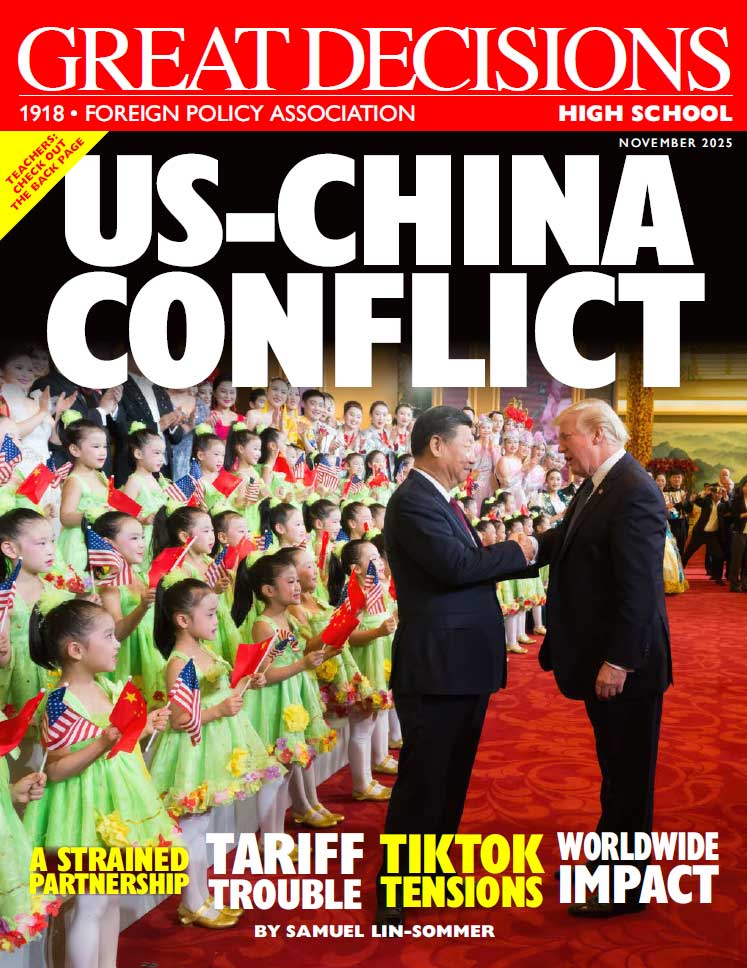
U.S.–China Relations: Competition or Cooperation? The U.S. and China stand at the center of today’s most consequential global relationship—one that shapes trade, technology, security, and the future of international leadership.Great Decisions: U.S.–China Relations, a free classroom resource from the Foreign Policy Association, helps students explore the history, tensions, and interdependence between these two nations through […]
Dive into the essential topics shaping our world with Great Decisions 2025 E-book editions! Whether you’re seeking to stay ahead in international trends or join engaging debates, Great Decisions 2025 is your passport to understanding. Find your preferred e-book format and retailer below to get started: Barnes and Noble – Read on your Nook or any compatible device.Kobo – For […]

