
Alvaro Uribe has received a great deal of criticism over his last few years in office from anti-trade advocates in the US, human rights groups and some of Colombia’s neighbours, especially Mr. Chavez, but despite this he was one of the most popular freely elected leaders in any country worldwide in the last 20 years. During his own campaign, an assassination attempt on his life came from his direct approach in tackling the drug cartels in Colombia at the time and the desperation and lack of control by the Colombian government over its own territory. The political temperature pre-Uribe placed Colombia at the brink of becoming a massive narco-state and very few experts and political leaders in Colombia and abroad knew how to deal with Colombia’s internal struggle. Since the early years of Uribe, Colombians and their support for their president grew to a point of Yes We Can times 50. The eventual cooling in drug violence and a proactive approach to the War on Drug by President Uribe slowly made him one of the most popular leaders to ever be elected in Latin America and arguably worldwide. Lately, actions like the capture and deaths of many FARC commanders and the bold rescue of Madam Betancourt and some American hostages placed Uribe in the record books as his ultra-popularity and aggressive fight against FARC, challenging rhetoric from Chavez and push to rebuild the Colombian economy and ensure its security solidified his reputation as one of Colombia’s most important modern Presidents. The end of Uribe’s term in office has come however, even as his popularity continues to maintain its strength. Moves to keep Uribe in office were unable to bypass the Colombian Constitution and term limits for a leader to remain in power in Colombia. At the end of his term in office, the first round of the elections are taking place this week, with a final round to be completed in three weeks from now.
This past weekend seemed to show the preference by Colombians for a new president that would continue securing Colombia for the time being, despite the level of relative growth and security now experienced in much of Colombia compared to ten years ago. Uribe’s choice candidate and former defence minister Juan Manual Santos did not achieve the 50% of the vote needed to win the election outright, but did receive a large number of the votes, 46.6% over his rival, former Bogota mayor Antanas Mockus. Support for Mockus from young Colombians and those in Bogota who saw him as a skilled leader and trusted politician boosted his popularity before the election to over 35% of the vote, but after the first round this Sunday, his actual support rested at 21.5%. This will allow Mockus an opportunity to challenge Santos on June 20th for the Presidency, but will leave him little opportunity for victory in the vote later this month.
It is not surprising that security and those who worked with Uribe to achieve successes in Colombia’s internal War on Drugs would receive so much solid political support, as some recent aggressive attacks by the FARC and other groups in Colombia as well as massive drug related conflicts in Mexico, Jamaica and the beginning of such conflicts in Brazil could easily degrade Colombia’s achievements and interal security rapidly. Other possible reasons for Colombian’s choosing a leader that is seen as one with a lot of strength and the backing of Uribe would be Venezuela’s involvement in Colombia’s internal struggles and the belief by many in Colombia and Colombia’s government that Venezuela has been supporting the FARC and other groups with high-tech weaponry and training. Over the last few years Colombians have been receiving news of Venezuela’s military growth. Chavez has been purchasing top of the line Russian equipment such as the SU-35, the modern version of the SU-27 variants of air superiority fighters, complimented by possible purchases of the S-300 and TOR-M1 anti-aircraft missile systems. All these activities might possibly be framed by Colombian and US concerns over Venezuela’s aggressive political moves to involve Colombia, Brazil and South America in geopolitical issues with Iran and its nuclear weapons program. Agreements between Venezuela and Iran and the recent film by Oliver Stone on Chavez could place Colombia’s next president in the position of defending Colombia’s interests in Latin America and possibly outside the region. Colombia will need a President that will be able to handle its strong foes, and even stronger allies if it is to break out of its internal struggles. Colombia was one seen as a model for institution building and economic growth. Whoever is to win, it can be assured that Colombian’s would wish to return to this era and to its former reputation nearly 40 years ago as Latin America’s institutionally stable and prosperous economy.

Edited by G. John Ikenberry. Proposed Essay Topics 1) American Foreign Policy and the Future of Multilateralism Over the postwar decades, the United States played a leadership role in building multilateral regimes and institutions across a wide range of policy areas. It was a founder of the United Nations and champion of the Bretton Woods […]
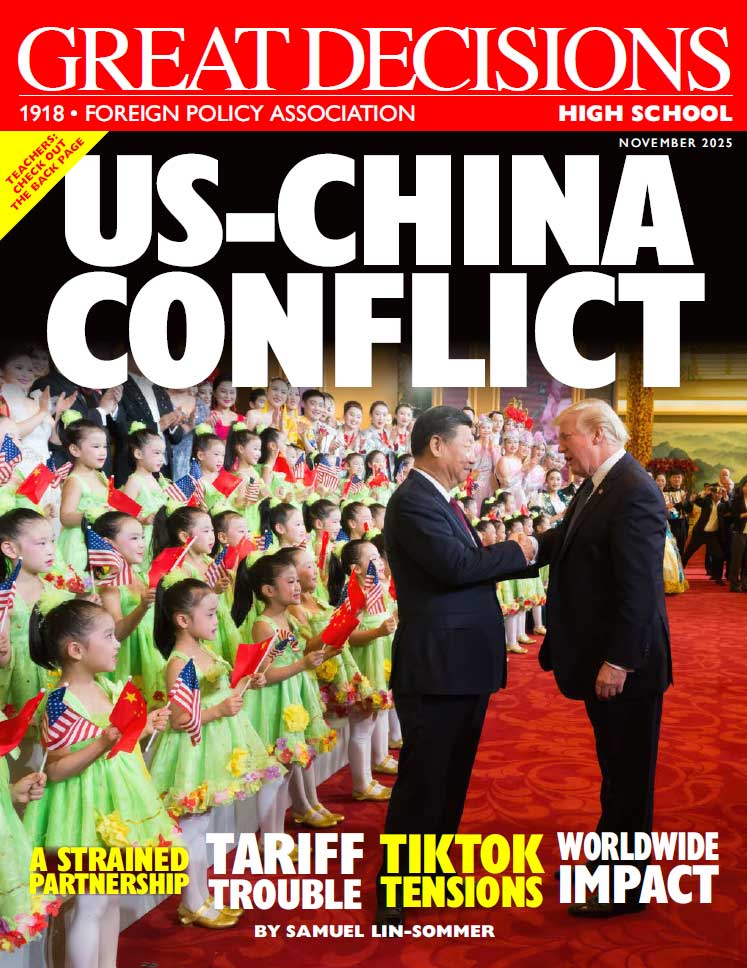
U.S.–China Relations: Competition or Cooperation? The U.S. and China stand at the center of today’s most consequential global relationship—one that shapes trade, technology, security, and the future of international leadership.Great Decisions: U.S.–China Relations, a free classroom resource from the Foreign Policy Association, helps students explore the history, tensions, and interdependence between these two nations through […]
Dive into the essential topics shaping our world with Great Decisions 2025 E-book editions! Whether you’re seeking to stay ahead in international trends or join engaging debates, Great Decisions 2025 is your passport to understanding. Find your preferred e-book format and retailer below to get started: Barnes and Noble – Read on your Nook or any compatible device.Kobo – For […]

