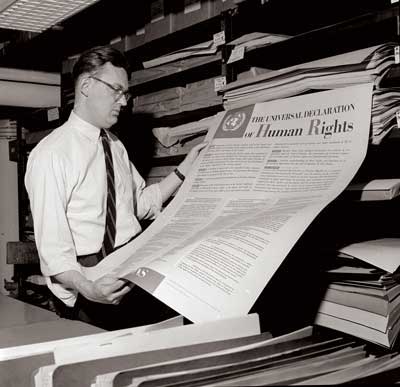
José E. Alvarez argues that while the international human rights regime—built after World War II as a universal legal and moral framework—is facing its most serious crisis due to populist backlash, geopolitical fragmentation, and doubts about effectiveness and universality, it remains resilient and could either erode, stagnate, or evolve into a reformed system that better integrates economic, social, and cultural rights in a divided world.
Browse our Great Decisions topic resources and share your own with [email protected].
The-Sustainable-Development-Goals-Report-2024.pdf
UN Sustainable Development Goals – Overview06_15YaleHumRts_DevLJ155_2012_.pdf
Samuel Moyn – The Last Utopia (Review) – Core critique of U.S.-centrism and historical narrative.Best single starting point to understand the UN human rights machinery (treaty bodies vs charter bodies; HRC, UPR, Special Procedures).
OHCHR – Instruments & mechanisms (the UN “map” of the system)If someone asks “what do the experts actually say states must do,” this is where concluding observations, general comments, and state reports live.
UN Treaty Body Database (treaty-body outputs in one place)Grounds discussion in the core legal instruments and who has ratified what—critical for “universality,” “compliance,” and “selectivity” debates.
UN Treaty Collection (primary texts + status/ratifications)Among the most universal UN peer-review mechanism, useful for understanding how politics and human rights oversight intersect in practice, by country.
Universal Periodic Review (UPR) hub + country documentationDirect window into thematic experts (e.g., torture, freedom of expression) and what they find on country visits—highly readable compared to treaty-law text.
OHCHR Special Procedures – country visits databaseShows recommendations from multiple UN mechanisms in one place—useful for “does any of this translate into implementation?” questions.
UN National Recommendations Tracking Database (NRTD)Excellent for non-experts who prefer short lectures; strong for “how did we get this system?” and “how do treaty bodies work?” without paywalls
UN Audiovisual Library of International Law – Human Rights lectures & research linksA major investigative NGO perspective; useful for participants who want empirical narratives and case examples of rights backsliding.
Human Rights Watch – Publications / World Report ecosystemA second major NGO perspective that often frames trends somewhat differently than HRW; good for triangulation and debate.
Amnesty International – Annual Report archive (State of the World’s Human Rights)Shows admissibility/merits/friendly settlements; useful for understanding the broader Inter-American system beyond the Court’s judgments.
Inter-American Commission on Human Rights – case reports databaseHelpful for balancing Euro-Atlantic lenses and seeing how norms develop in different institutional contexts (coverage and UX vary across tools).
African human-rights case-law collectionsA curated directory of reliable databases (including UN documentation tools like RightDocs); ideal for participants who want to dive deeper.
HURIDOCS – Human Rights Research Databases directory (meta-library)



Lecture: Professor Philip Alston
London School of Economics: The Populist Challenge to Human RightsGreat Decisions 2026: The Future of Human Rights & International Law (WorldOregon)
Great Decisions – World Oregon75 years ago, the United Nations General Assembly adopted the Universal Declaration of Human Rights as a common human rights standard for all everyone, everywhere. This video provides the history, content, and ongoing significance of the document.
Universal Declaration of Human Rights -UNA concrete lens on the expanding “human rights + business/supply chains” domain—useful for participants to see how the field has broadened beyond classic civil/political rights.
Cobalt Red with Siddharth Kara (Foreign Policy Association)A strong “big ideas” foundation (where rights come from; why the concept is contested) without partisan framing.
The Burning Issue: The DNA of Human RightsDirectly addresses the populist/backlash dynamics that Alvarez discusses (reformist/analytical frame).
LSE Events | Professor Philip Alston | The Populist Challenge to Human RightsA principled defense of human rights as a governing idea—useful to balance “the system is failing” critiques.
Human rights: the case for the defence | LSE EventA simple mechanism explainer (what the HRC is) that helps participants understand institutions, not just ideals.
The UN Human Rights Council at a glanceQuick orientation to what the Council does and common critiques (politics vs oversight).
The UN Human Rights Council: Five Things to KnowThe basic idea of human rights is that each one of us, no matter who we are or where we are born, is entitled to the same basic rights and freedoms. That may sound straightforward enough, but it gets incredibly complicated as soon as anyone tries to put the idea into practice. What exactly are the basic human rights? Who gets to pick them? Who enforces them—and how? Benedetta Berti explores the subtleties of human rights.
What are the universal human rights? – TED-ed

Share your thoughts on this topic with [email protected]
Leave your thoughts on this topic by leaving a comment...