
Whether foreign investments are flowing into Brazil as a river or as a trickle, Brazil’s reputation as the next large fast growing super economy is being cemented by the attention it has received after 2009 as the BRICS that may become the next China. While China and Brazil are growing in different ways for different reasons, comparisons will abound as Brazil grows into its own and investors will continue to draw comparisons between the two BRICS. China itself has recognised the potential of a growing Brazil and Latin America and is spending a lot of time and money in what used to be known as America’s backyard. Much of China’s interest in Brazil comes from Brazil’s and Latin America’s natural resource rich economies that China requires in order to sustain its own economic boom and rapid growth. According to Xinhua, since 2009 trade between China and Latin America has doubled to $180 billion. Taking advantage of Brazil’s boom, last week Chinese Vice President Xi Jinping toured Brazil in order to encourage Chinese companies to invest more in Brazil and the region as a whole. It is clear that while China and Brazil may differ in many ways, the differences between the two countries have a great benefit for both nations.
A region of Brazil which has been called “The China of Brazil” due to its reputation of traditionally being poorer and underdeveloped, Brazil’s Northeast is becoming a magnet for foreign investors and is taking the benefit of new infrastructure and jobs in the process of reindustrialisating that region of Brazil. Foreign companies and local industry and government are taking regions in Brazil’s Northeast that were often last in priority from Brazil’s megacities of Rio and Sao Paulo and Brazil’s industrialised south and turning them into the home of some of the world’s largest companies operating in Brazil. In response to operating in unique regions of the country, many foreign firms has adopted locally interesting marketing campaigns in order to integrate further into Brazil and the individual regions in where they now operate.
The China of Brazil is not only named this for the rates of low income as compared to the rest of Brazil, but for the manner in which communities purchase goods, maintain their home, the larger size of families and how they are raised while purchasing lower income products. It is true that low income and larger families are not a global constant and even within Brazil and within China there are varied social and cultural differences within countries as well. Rural China and parts of Brazil that have lower income residents may have as much in common as rural Russia or low income areas of Mumbai, but for investors the statistical limits and the potential for markets may be crucial enough to transmit some of the investment excitement around China towards Brazil’s less developed regions such as the Northeast. Whatever the reason, the focus on the economic and cultural variations of Brazil’s Northeast can contribute to investment and a reduction of poverty while importing pretty shoes that people in the West, many parts of China and Southern Brazil currently enjoy. Perhaps even those shoes will become an exported specialisation of the Northeast of Brazil while providing stable jobs in the process.

Edited by G. John Ikenberry.Cover image download. Proposed Essay Topics 1) American Foreign Policy and the Future of Multilateralism Over the postwar decades, the United States played a leadership role in building multilateral regimes and institutions across a wide range of policy areas. It was a founder of the United Nations and champion of the […]
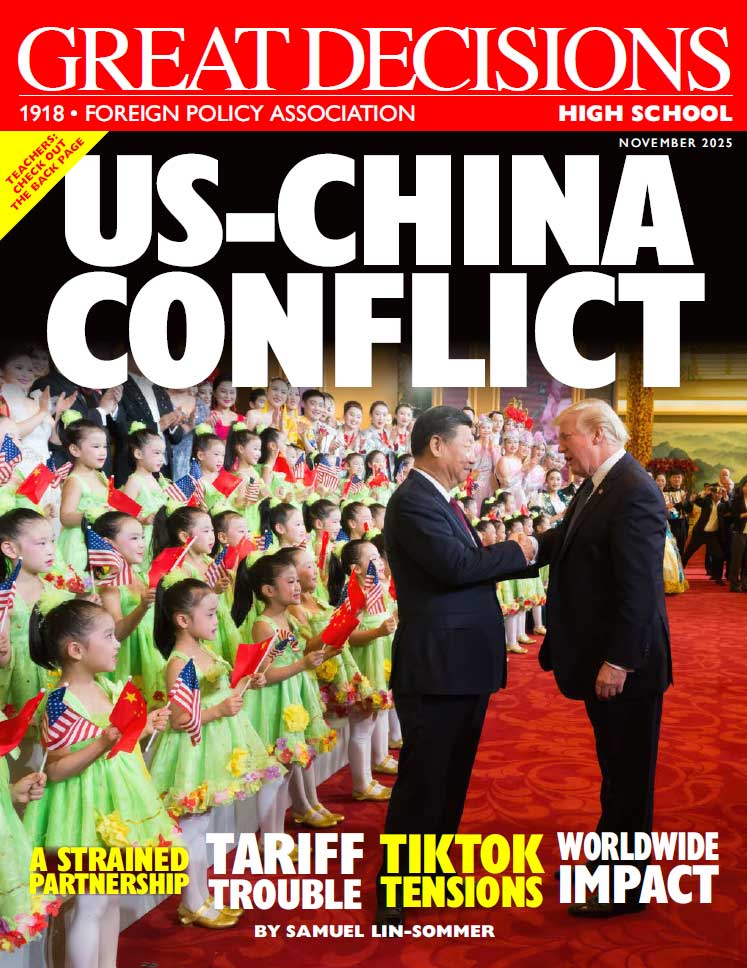
U.S.–China Relations: Competition or Cooperation? The U.S. and China stand at the center of today’s most consequential global relationship—one that shapes trade, technology, security, and the future of international leadership.Great Decisions: U.S.–China Relations, a free classroom resource from the Foreign Policy Association, helps students explore the history, tensions, and interdependence between these two nations through […]
Dive into the essential topics shaping our world with Great Decisions 2025 E-book editions! Whether you’re seeking to stay ahead in international trends or join engaging debates, Great Decisions 2025 is your passport to understanding. Find your preferred e-book format and retailer below to get started: Barnes and Noble – Read on your Nook or any compatible device.Kobo – For […]

