
Last Friday, March 23rd, I attended a special event titled “Water: The Global Challenge For Our Future” at NYU’s Center for Global Affairs on the occasion of World Water Day 2012, held annually on March 22nd. This year’s theme intended to draw attention to the relationship between water and food security. As the Food and Agriculture Organization (FAO) of the United Nations pointed out: “in all steps of the supply chain, from producers to consumers, actions can be taken to save water and ensure food for all”. To the point, UN Water puts it nicely into context and describes the actual magnitude of the problem: “There are 7 billion people to feed on the planet today and another 2 billion are expected to join by 2050. Statistics say that each of us drinks from 2 to 4 litres of water every day, however most of the water we ‘drink’ is embedded in the food we eat: producing 1 kilo of beef for example consumes 15,000 litres of water while 1 kilo of wheat ’drinks up’ 1,500 litres. When a billion people in the world already live in chronic hunger and water resources are under pressure we cannot pretend the problem is ‘elsewhere’.”
Well, dear reader in the developed world you may think that this sounds like a problem only prevalent throughout the developing world. Not so fast! Allow me to broaden the issue first in order to also understand why the UN General Assembly designated 2013 as International Year of Water Cooperation. Water, energy, and agriculture make the tripod that supports human civilization. The accessibility, availability, and affordability of water, energy, and food supplies are inexorably interlinked. By adequately addressing this just mentioned ‘AAA’-Tripod the prospects for alleviating global poverty, reducing global tensions (possible ‘water wars’) between upstream and downstream countries, at least stopping environmental degradation, and providing the basis for significantly improving public health and social well-being would be better.
All this requires public awareness including in the developed world. Please note, we have water shortages in California (USA). The controversial debate about ‘fracking’ which is a hydraulic fracturing technology that energy companies hope to use to expand natural gas production by getting access to the more difficult to reach natural gas reserves trapped within shale formations in the United States is another example. The latter example actually makes us aware of the critical nexus between energy and water because our ground-water could get contaminated in this process. Further, just think about where you find nuclear power plants generating electricity for urban populations. Yes, adjacent to ‘water’ – rivers or oceans (e.g. Fukushima, Japan). All that should make clear that given the linkages I have described above, those are tough decisions and basically trade-offs. Nothing is risk-free and you pick your poison. But given that globally everybody is interested in rising living standards and given the global population growth, it is reasonable to expect that the need for electricity and water will only rise because economic development and rapid urbanization require more and more water resources.
However, and here is a crucial point to be made: We need to regard water as a commodity just like oil and perhaps need to assign a certain market-based value to it. During a panel discussion at the aforementioned event Professor Chris Gadomski (Center for Global Affairs, NYU-SCPS) likened the depletion of ground-water – a natural resource – to the depletion of any fossil fuel such as oil. Other panelists also made clear that once the ground-water was gone, it was simply gone. Therefore, water has to be used sustainably – for agriculture, human use and energy – and needs to be preserved (so-called “water resources management”). The water use globally is an unsustainable practice. To sum up the overall conclusion of the panel: If societies around the world continue to deplete the natural resource of fresh water, they will pay a heavy price later on. However, note that it is very difficult, often impossible and very costly to reconstitute the precious status quo ante of nature and therefore it is better to work with the free natural system within the ecosystem.
I would like to add – something not brought up during the discussion – that in a market-based system scarce resources command higher prices. Think of the price of oil, which is in the news every single day. This is the way to create public awareness because once higher prices have an impact on discretionary spending, most people start to care. Now, someone might argue that if I fill up a tanker with oil I will have something of value in dollar terms whereas if I fill up the tanker with water I basically have nothing of real value. Granted, that is true. However, this does not absolve us from finding an adequate pricing mechanism along the lines of the carbon taxes imposed in Australia or Europe.
The editor of Oilprice.com James Stafford recently spoke with energy specialist Dr. Tom Murphy, an associate professor of physics at the University of California. Among other topics he addressed the pitfalls of the shale boom, why resource depletion is a greater threat than climate change and why Fukushima should not be seen as a reason to abandon nuclear energy. Basically, this interview covered the nexus between energy and environment and Dr. Murphy reached interesting conclusions to ponder.
Dr. Murphy stressed in this interview in particular that “resource depletion trumps climate change for me, because I think this has the potential to effect far more people on a far shorter timescale with far greater certainty. Our economic model is based on growth, setting us on a collision course with nature. When it becomes clear that growth cannot continue, the ramifications can be sudden and severe. So my focus is more on averting the chaos of economic/resource/agriculture/distribution collapse, which stands to wipe out much of what we have accomplished in the fossil fuel age. To the extent that climate change and resource limits are both served by a deliberate and aggressive transition away from fossil fuels, I see a natural alliance. Will it be enough to avert disaster (in climate or human welfare)? Who can know – but I vote that we try real hard.” This statement only underlines what I have elaborated on in greater detail above in regards to water and the connected looming challenges.
Finally, Dr. Murphy offers the excellent advice to “acknowledge that once our inheritance is spent, we may not live like the kings we want to be. If, instead, informed people accepted limitations of future energy supplies, and modified their own behaviour accordingly under their own control, we would break the habit of people taking energy for granted (…). We want greater personal awareness of energy, not less.” Moreover, he suggests that “the very simple answer staring us in the face, yet somehow unthinkable, is to consume far fewer resources and aim to reduce population. Hopefully we can do this in a more controlled way than nature may enforce if we ignore the myriad warnings. This “solution” will no doubt offend many, but just because we want to continue growth does not mean we can.“
In sum, it is in our own interest to change our unsustainable practice of depleting our natural resources. However, change will be very slow, unfortunately demographics will not save us, and Dr. Murphy is absolutely correct in stating that we would be better off to take charge of our own destiny by voluntarily adjusting instead of being cornered by nature.

Edited by G. John Ikenberry.Cover image download. Proposed Essay Topics 1) American Foreign Policy and the Future of Multilateralism Over the postwar decades, the United States played a leadership role in building multilateral regimes and institutions across a wide range of policy areas. It was a founder of the United Nations and champion of the […]
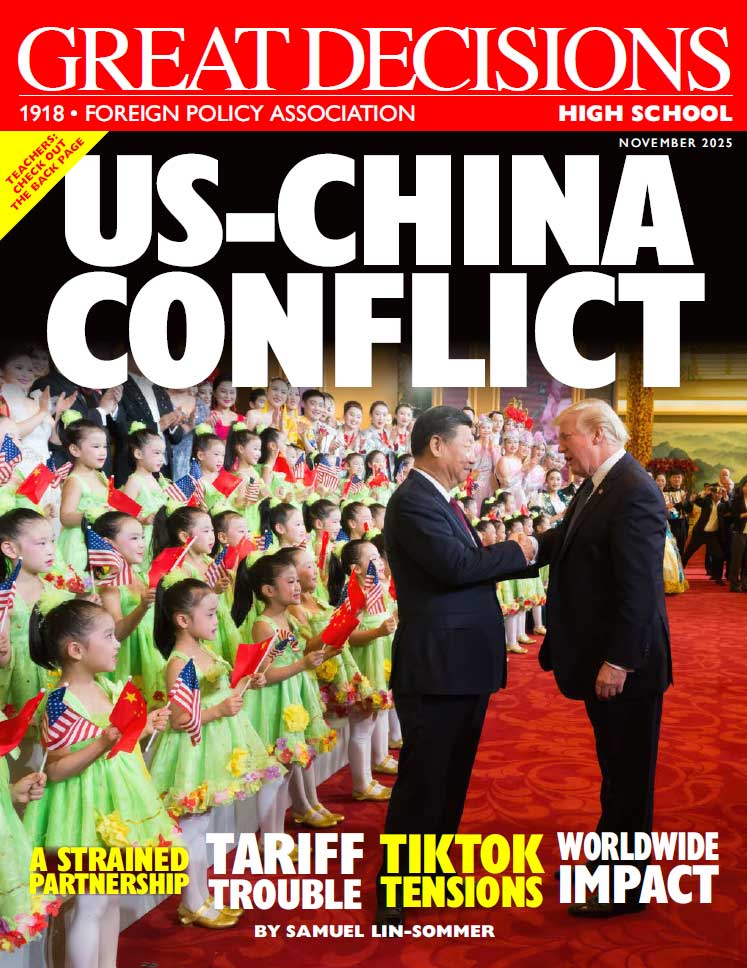
U.S.–China Relations: Competition or Cooperation? The U.S. and China stand at the center of today’s most consequential global relationship—one that shapes trade, technology, security, and the future of international leadership.Great Decisions: U.S.–China Relations, a free classroom resource from the Foreign Policy Association, helps students explore the history, tensions, and interdependence between these two nations through […]
Dive into the essential topics shaping our world with Great Decisions 2025 E-book editions! Whether you’re seeking to stay ahead in international trends or join engaging debates, Great Decisions 2025 is your passport to understanding. Find your preferred e-book format and retailer below to get started: Barnes and Noble – Read on your Nook or any compatible device.Kobo – For […]

