
Cuban voters have so far held over 21,800 assemblies to nominate candidates to the People’s Power Municipal Assemblies (local governments) for 2010 elections. The elections will be held tomorrow, and on May 2 where there will be a second round in the constituencies if none of those nominated wins over 50 percent of valid votes.
So in theory, candidates are directly chosen by neighborhoods and communities in Cuba, which decide amongst themselves whom they would like to represent them. For this reason, the Cuban government trumpets its elections as the most democratic in the world (compare to Western powers’ accusations that the country is entirely undemocratic).
The problem seems not to be with ease of voting, turnout, or lack of non-Communist Party candidates to choose from. All citizens of Cuba are eligible and automatically registered to vote when they reach age 16. No campaigning is allowed in order to level the playing field: each candidate gets a photo and bio of the same size posted in public places, and there are no radio, TV, or billboard campaign ads. And there are many candidates that are from unions and other groups, unaffiliated in an official sense with the Communist Party.
Instead, the problem reported by some Cubans is that of intimidation. Voting is not mandatory by law, but non-voters and voters for unusual candidates apparently face social exclusion and other problems within social and labor circles. So although a high percentage of Cubans (around 85%) attend the assemblies to nominate candidates, not all of these actually even participate there. Nominating a “dark horse” candidate is seldom done, and one can assume from the high rate of abstention in the nominating process that some Cubans would rather nominate someone else but hesitate to do so and face negative consequences.
But we could also interpret that lack of dark horse candidates in another way. Dissident figures condemn their inability to garner votes by citing intimidation, but there is more to it: dissidents and opposition parties are largely unsupported by the Cuban people themselves. Not for any lack of merit, necessarily, but because, as we’ve discussed before, dissidents are often seen as “mercenaries” of foreign governments, in particular the United States. Why would anyone nominate individuals that are seen in this way? And so continues the eternal dilemma Washington faces: to support the opposition for the sake of encouraging fully representative and open democracy (and in so doing weaken their domestic credibility), or to extricate the U.S. government from its support of these groups (and in so doing weaken the U.S. government’s public stance on democracy promotion, a key domestic rallying issue)?
(AP Photo/Javier Galeano)
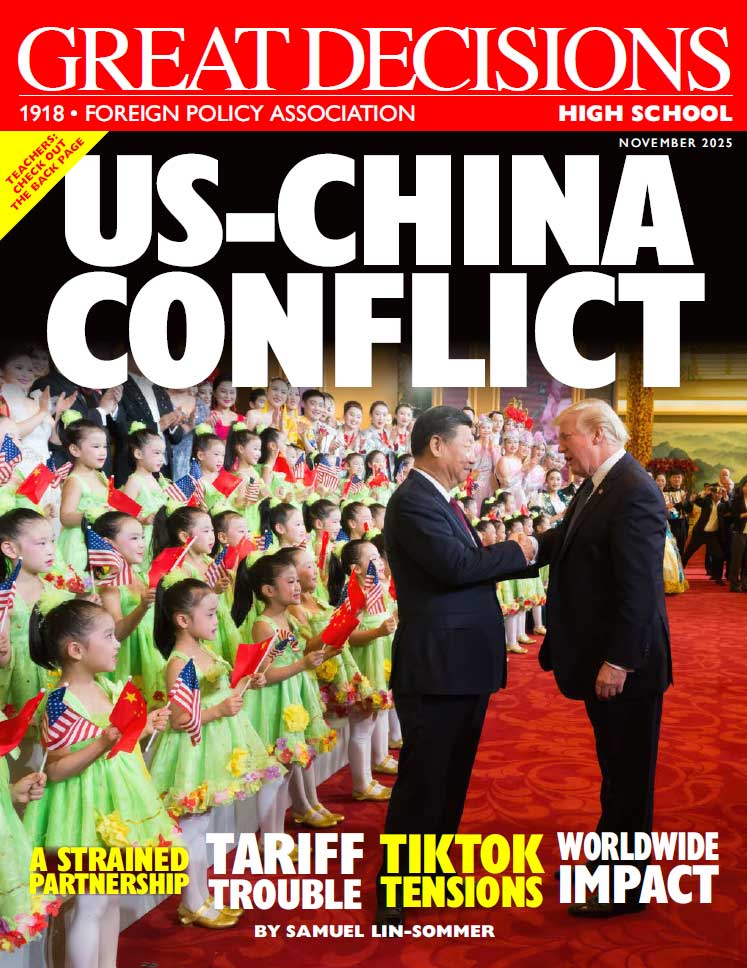
U.S.–China Relations: Competition or Cooperation? The U.S. and China stand at the center of today’s most consequential global relationship—one that shapes trade, technology, security, and the future of international leadership.Great Decisions: U.S.–China Relations, a free classroom resource from the Foreign Policy Association, helps students explore the history, tensions, and interdependence between these two nations through […]

Dive into the essential topics shaping our world with Great Decisions 2025 E-book editions! Whether you’re seeking to stay ahead in international trends or join engaging debates, Great Decisions 2025 is your passport to understanding. Find your preferred e-book format and retailer below to get started: Barnes and Noble – Read on your Nook or any compatible device.Kobo – For […]

