
Where do Middle Easterners fit in the cultural society and economic system of the Americas? This question has become part of much debate recently due to the Islamic Cultural Centre being built close to Ground Zero in New York and the response by many in the US that believe that it is an affront to those who died on 9/11. A different perspective of Middle Eastern culture and contributions in the Americas and an analysis of legal rights, obligations in a society and how courtesy affects tense situations will be discussed in an attempt to open perspectives on Middle Eastern societies living in the Americas.
The Americas as a whole has been a magnet for immigration from the Middle East since the late 19th century and has affected the progress of many nations in the Americas for over 100 years. Starting in New York, one of the most well known poets in the Middle East, Gibran Khalil Gibran, immigrated from what is now Lebanon to Boston and sought his career in New York. This Arab-American died in 1931, but is by far one of the most influential poets in the Middle East and grew up proud in the United States. In Latin America, immigration from the Middle East was substantial and made up many of the most influential families in the region. Brazil alone is noted to have more than 10 million descendants of Middle Eastern ancestry, with over 7 million direct from Lebanon, larger than the population of Lebanon itself. Mexico claims 400,000 people of Arab descent from Lebanon, and Chile counts over 500,000 of Palestinian origin. Argentina’s former President Carlos Menem’s parents were Syrian, and informally the wealthiest family in Mexico is of Lebanese ancestry. Actresses like Salma Hayek and Shakira also share Middle Eastern origins, and in Brazil alone, the largest Middle Eastern origin population exists around Sao Paulo and Rio de Janeiro making Latin America the region with the largest concentration of a Middle Eastern population outside of the Middle East.
While statistic give limited amounts of information, the real application of those generations of Middle Easterners in the Americas have had a great positive effect on the economic successes in Latin America. Descendants of those families from the Middle East are some of the most successful and well respected economic leaders in Latin America. Immigration from the Middle East to North America in recent years has often taken a different trend than in Europe, receiving many from the Middle East with a measure of wealth and education into the US and Canada, making North America one of the destinations for the best educated and most highly skilled from all over the Middle East.
So what do we believe of this population when an Islamic Centre is being built next to Ground Zero, and the reaction to it leads to a situation where the Quran is being burnt in Florida by a Pastor? The simple answer is that no books should be burned for any reason, even if it is to poke the eye of someone you believe is your enemy. It simply does not create any solution, even if you have the right to burn a book or a flag. The legal right to burn whatever document you want is well established in the US, but as a courtesy to those in the US who live by their faith and culture where the Quran is of significant importance it should be noted that this offence, while legal, is inappropriate.
Regarding the Islamic Centre, many Americans are personally affected by 9/11, but also by events such as when a US soldier and psychologist of Middle Eastern origin can massacre his fellow Americans in the name of his faith after growing up in the US and serving in its army. While the story on this soldier ended in the media fairly rapidly, such events must be considered beyond 9/11 when Americans are notably frustrated with the establishment of an Islamic Centre in an area where tensions would ought to be known to exist. Legally, as Mr. Obama is well aware of as a Harvard Lawyer, there is little that can stop the Imam and his supporters from building the Islamic Centre in the location beyond zoning issues within the law. Even the President of the United States does not have the right to take property away from private citizens. The right to own property and do whatever you wish with it within the law is paramount in the United States and cannot and should not be broken. On CNN this week, the Imam who was responsible for helping establish the Centre returned to the US from a tour in the Middle East promoting moderate ideals in the Islamic faith. In the interview, he said he likely would have not tried to establish the project if he knew it would have caused such tensions, but thought that there was no viable solution by either side at this point that would result in a peaceful reaction by extremists on either side.
It is unlikely that anyone would be unaware of the tensions of establishing the Islamic Centre so close to Ground Zero, even if legally viable, it would show a lack of courtesy to many no matter how open and transparent the Centre would be. Whether Americans should be offended or are overreacting to the establishment of a Centre, it might be worth while to create a solution beyond legal rights in order to produce a Centre that would become part of New York society instead of be seen as a lack of courtesy. In reality, like those Middle Easterners such as Gibran Khalil Gibran, not all from the region are Muslims, or Arabs or even speak Arabic. It would be a reasonable solution to create the structure as an education centre focused on Middle Eastern cultures and values from all faiths, as that is a true reflection of the Middle East and that culture within the US and the Americas. Included in this would be a Mosque and any other chapels of faiths that exist in the Middle East but often come to places like New York to expand their own cultures which is often difficult in their countries of origin. A small model of this is the Museo de Tres Culturas in Seville, Spain where the three cultures that established Spain’s golden age are documented, respected and even demonstrated with food and music. Such a solution is simply a reflection of the best parts of the Middle East, and in the end a felafel and some music is something everyone can agree to positively. That is the best and most simple solution, and could become one of New York’s great landmarks.
For a discussion on how young Muslims can become radicalised in Canada and UK, see TVO’s The Agenda’s Sept 8th Broadcast here, video to be posted soon.
For the CNN discussion with the NYC Imam Feisal Abdul Rauf, see a link here and a video link here.
For a lighter perspective on Middle Easterners, see Maz Jobrani here.
For a window on Shakira’s Middle Eastern heritage, see her video Ojos Asi live in Dubai here.

Edited by G. John Ikenberry. Proposed Essay Topics 1) American Foreign Policy and the Future of Multilateralism Over the postwar decades, the United States played a leadership role in building multilateral regimes and institutions across a wide range of policy areas. It was a founder of the United Nations and champion of the Bretton Woods […]
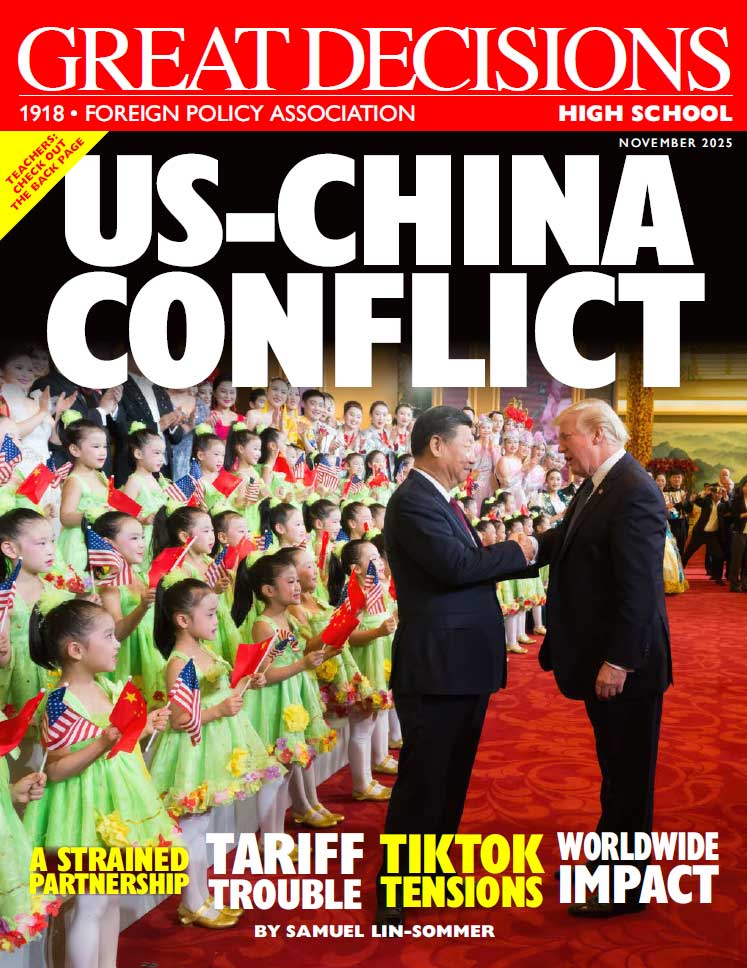
U.S.–China Relations: Competition or Cooperation? The U.S. and China stand at the center of today’s most consequential global relationship—one that shapes trade, technology, security, and the future of international leadership.Great Decisions: U.S.–China Relations, a free classroom resource from the Foreign Policy Association, helps students explore the history, tensions, and interdependence between these two nations through […]
Dive into the essential topics shaping our world with Great Decisions 2025 E-book editions! Whether you’re seeking to stay ahead in international trends or join engaging debates, Great Decisions 2025 is your passport to understanding. Find your preferred e-book format and retailer below to get started: Barnes and Noble – Read on your Nook or any compatible device.Kobo – For […]

