
Long thought to be a volatile, potentially destructive force in liberalizing economies, capital flows are curtailed through a variety of taxes, limits or deposit requirements.
Such capital controls serve as a kink, allowing policymakers a freer hand to manage their economies.
Brazil recently initiated one such measure, a 2% tax on the purchase of Brazilian equities or bonds by foreigners. Regardless of what officials say, the tax is meant to reign in Brazil’s currency, the real, which has appreciated some 50% against the dollar since December. At about 1.75 reais to the dollar, the real now sits at pre-recession levels, whereas the Mexican peso is still down by over 15%. As risk appetite returns, Brazil is situated to receive a fresh wave of capital investment, further strengthening the real and undercutting the competitiveness of Brazilian exports.
Transparency and sound corporate regulation should obviate capital controls, but such reforms take time. With rampant corruption and economic crisis in the not too distant past, Brazil hasn’t arrived at that point. The recent tax is a prudent move—for now. It is moderate, and targeted at incoming capital rather than outflows.
Still, the IMF from criticized the move. IMF Chief Dominique Strauss-Kahn labeled Brazil’s capital controls as “ineffective” and went on to argue that capital controls are costly to the nations that adopt them. Dani Rodrik defended Brazil’s decision, or rather issued a technical critique of the IMF’s position, stating that the Fund cannot simultaneously insist that capital controls are both costly and ineffective.
Just as wonks at the Fund must balance political and economic realities, so too must Brazil’s policymakers. As a member of the quasi-free trade BRIC clan Brazil’s policies are likely to influence RIC, so any steps away from market liberalization runs the risk of emulation. (See: beggar-thy-neighbor.) Unfair play by one BRIC member could feed a destructive spiral of market manipulations by others. Regular interventions in capital markets, or monetary policy more broadly, could ensue, deflating the prosperity that should accrue from globalization. Thankfully, that doesn’t appear to be the case, but it’s a pitfall to be mindful of.
Crucially, Brazil doesn’t seem interested in rigging capital markets to perennially undervalue its currency the way China does. This is at least partly the result of Brazil being a democracy, so it can’t just focus on export-led growth while ignoring domestic consumption. By making its capital controls explicit Brazil is adding transparency to the investment process and because the tax is small, policymakers can make incremental adjustments, which should minimize the risk of any readjustment spooking capital investment.
Bravo for a responsible intervention. But the real remains on an upward slog.

Edited by G. John Ikenberry.Cover image download. Proposed Essay Topics 1) American Foreign Policy and the Future of Multilateralism Over the postwar decades, the United States played a leadership role in building multilateral regimes and institutions across a wide range of policy areas. It was a founder of the United Nations and champion of the […]
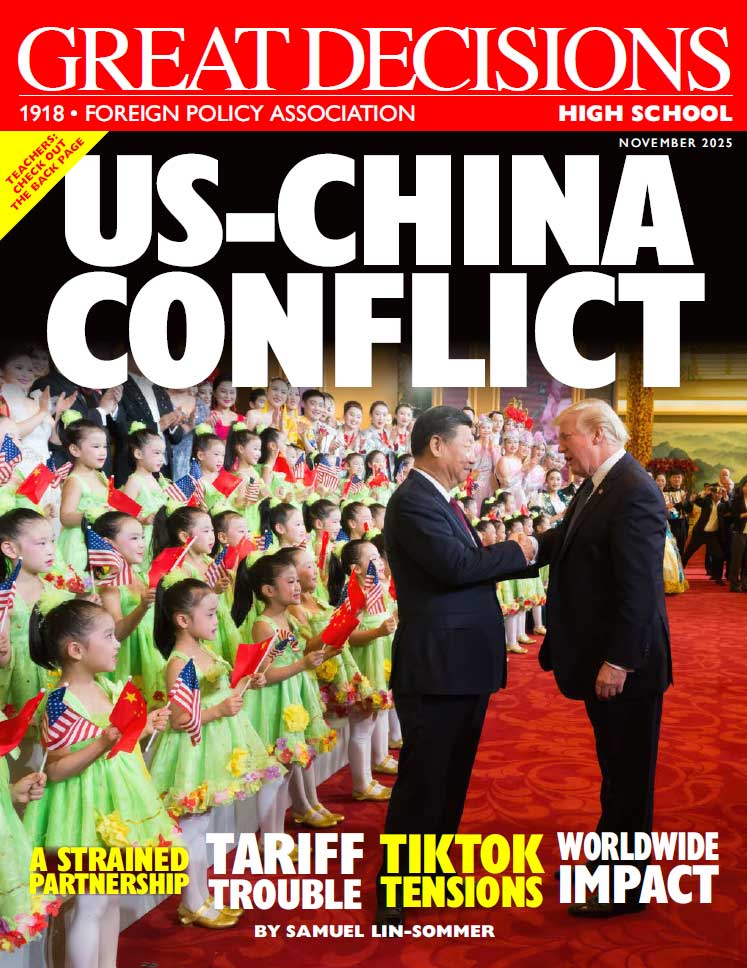
U.S.–China Relations: Competition or Cooperation? The U.S. and China stand at the center of today’s most consequential global relationship—one that shapes trade, technology, security, and the future of international leadership.Great Decisions: U.S.–China Relations, a free classroom resource from the Foreign Policy Association, helps students explore the history, tensions, and interdependence between these two nations through […]
Dive into the essential topics shaping our world with Great Decisions 2025 E-book editions! Whether you’re seeking to stay ahead in international trends or join engaging debates, Great Decisions 2025 is your passport to understanding. Find your preferred e-book format and retailer below to get started: Barnes and Noble – Read on your Nook or any compatible device.Kobo – For […]

