
Actor Alec Baldwin ran a piece on Cuba in the Huffington Post today as a response to the recent announcement that the New York Philharmonic would no longer perform in Havana at the end of this month. The Orchestra’s decision came after the U.S. Treasury Department denied the necessary permission for travel to Cuba to the Philharmonic benefactors who would facilitate the performance. Until that moment, the planned visit had been viewed as an unprecedented show of cultural diplomacy between the United States and Cuba.
Baldwin’s piece in HuffPo (which can be found here) is reproduced below. It is always interesting when an entertainment icon gets involved in political discourse, as it tends to draw in a different crowd to the issue—sometimes a far less informed crowd. In this case, his piece deals directly with the arts—his own field, really—which perhaps lends to his credibility on the subject.
Alec Baldwin, Huffington Post
The New York Philharmonic will soon be departing for it’s “Asian Horizons” international tour, with stops in Seoul, Tokyo, Hanoi, Singapore, Abu Dhabi and Al Ain. However, one destination that has, at least temporarily, been scratched from the Philharmonic’s foreign schedule is Havana.
The separate trip to Cuba, scheduled for the end of October, has been postponed due to U.S. Treasury Department regulations. Specifically, a contingent of Philharmonic benefactors, who were underwriting a portion of the trip to Havana, would be spending money in Cuba in violation of current U.S. law. The orchestra it self was permitted to go, but not the convoy of their financial benefactors.
So the Philharmonic is free to bring its singular program of cultural exchange to the former North Vietnamese capital, a nation with whom we were at war with as late as 1975, that war having cost over 55,000 U.S. lives. But it is prohibited from doing so in Cuba because…..? As recently as Monday, October 5th, Senator Byron Dorgan (D-ND) spoke on the Senate floor to deride current regulations. “This is almost unbelievable what we are still doing with respect to travel policy with Cuba,” Dorgan said.
The political heritage of the Cuban American people notwithstanding, it is time for the embargo on U.S. travel to end. The people most responsible for the creation of this political reality are dead. Some of them long dead. Castro is in the last chords of his own life. Who, then, benefits from continuing this policy?
The Cuban American community, who truly suffered the upheaval, savagery and indignation of losing their homeland to the Communists can never be compensated. One could never equate the current order as being the result of merely a “grudge.” Yet, nothing can bring back their Cuba. It is gone. Even if Cuba had not been, as one friend once described to me, “embedded in amber” these past several decades, the rest of the world has moved on.
There is, however, a New Cuba that can be reclaimed. Investment is paramount, no doubt. But a relationship with the rest of world may be needed first. The New York Philharmonic, one of the premiere classical music institutions in existence, cannot afford to knock on Cuba’s door without financial support from its generous contributors, especially in these difficult economic times. Performing arts institutions like the Philharmonic have long understood the necessity for cultural projects like this. As much as our allies and potential allies want aid, food, and America’s brand of political rhetoric in their ears, they also want something else. Like Ravel and Stravinsky and Beethoven and de Falla.
The embargo on Cuban travel should be lifted, at the very least, for cultural projects like the one by the Philharmonic that was just delayed by the U.S. Treasury Department. If a hundred or so patrons accompany them as a means of facilitating the trip, they should be allowed to go, too.

Edited by G. John Ikenberry.Cover image download. Proposed Essay Topics 1) American Foreign Policy and the Future of Multilateralism Over the postwar decades, the United States played a leadership role in building multilateral regimes and institutions across a wide range of policy areas. It was a founder of the United Nations and champion of the […]
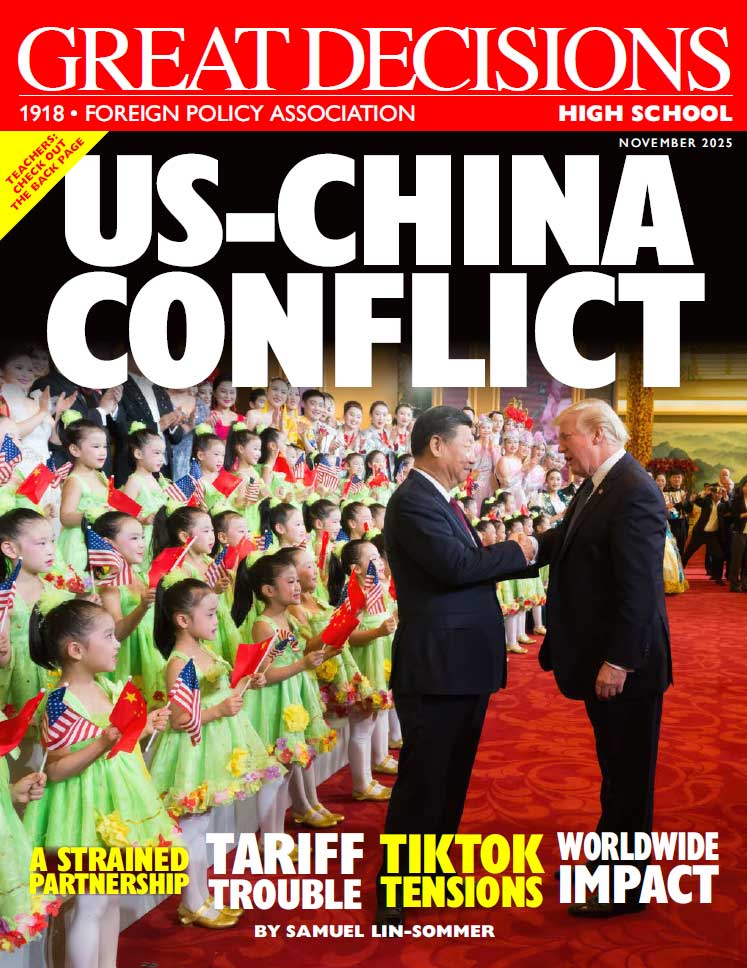
U.S.–China Relations: Competition or Cooperation? The U.S. and China stand at the center of today’s most consequential global relationship—one that shapes trade, technology, security, and the future of international leadership.Great Decisions: U.S.–China Relations, a free classroom resource from the Foreign Policy Association, helps students explore the history, tensions, and interdependence between these two nations through […]
Dive into the essential topics shaping our world with Great Decisions 2025 E-book editions! Whether you’re seeking to stay ahead in international trends or join engaging debates, Great Decisions 2025 is your passport to understanding. Find your preferred e-book format and retailer below to get started: Barnes and Noble – Read on your Nook or any compatible device.Kobo – For […]

