
According to a recent poll by Latinobarómetro, a public opinion survey conducted in 18 countries in the Latin American region, 45% of Brazilians agree that “democracy is preferable to any other type of government.”[1] Alarmingly, the figure is down from 54% last year. The Economist proposes an explanation: “Dilma Rousseff, the new President, has taken a tough line on corruption, thus drawing more attention to it.” Since June, 6 of Dilma’s ministers have been forced out of the Cabinet; 5 due to corruption scandals. As Brazil analysts have pointed out, Dilma’s intentions may be progressive, but the exodus cannot be fully understood as a laundering of Brasília’s ministries. The exits may have an opposite effect, as they are a rip in the fabric of her governing Coalition.
As a recap, Dilma’s Cabinet has been turbulent to say the least. 6 officials of the administration have left since June, and 5 did so due to corruption allegations. All 6 were part of the government of Dilma’s mentor Luiz Inácio Lula da Silva. The timeline goes as follows[2]:
Commentators have tried to diagnose the exodus; explanations I will discuss here include both competition for scarce government patronage resources and philosophical disagreement over the proper relationship between government and the governed.
In their piece “The Price of a Disproportional Cabinet: The Paloccigate in Brazil,” Carlos Pereira and Carlos Aramayo of the Brookings Institution identify a key challenge of Dilma’s Cabinet as under-representation of minority parties.[4] The relative size of Dilma’s Worker’s Party (PT) in the Chamber of Deputies demonstrates Dilma’s reliance on these minority parties. While Dilma’s multi-party Coalition holds about 64% of seats in the Chamber of Deputies (326 seats out of 513), the PT itself holds 88 seats (27% of the Coalition, and 17% of the entire Chamber). According to data from Pereira and Aramayo, PT members hold 17 out of 37 Cabinet posts, or 46% of the total. In analyzing Palocci’s resignation as Dilma’s Chief of Staff, Pereira and Aramayo note that Palocci had been forced to resign from Lula’s government due to prostitution allegations, but that he never lost support of his party. In the case of his recent resignation the Cabinet, and specifically its PT members, withdrew support. Pereira and Aramayo imply that PT members turned on Palocci because his recent misdeeds led to personal profit, while explaining rebellion in the rest of the Coalition “as the price Rousseff paid for allocating a disproportionate cabinet.” Pereira and Aramayo also note that Dilma missed an opportunity post-scandal to equitably realign the Cabinet. Further internal discord may ensue, particularly given another expected Cabinet realignment prior to mid-term elections next year. Analysts note that the key catalyst in Dilma’s drive has been the Brazilian press, who originated many allegations of wrongdoing, and will be eager to publish further allegations in the inter-Coalition struggle for government resources.[5]
The Economist posits that Dilma’s key challenge may be larger than a misaligned Cabinet; rather, she does not agree with her Coalition partners on how Brazilian government should be run. The Economist optimistically notes Dilma’s focus on government efficiency; she has left many government jobs unoccupied, and added independent technocrats to the government at the expense of party stalwarts. Combined with the firing of unclean Cabinet ministers, these actions have caused senior leaders within her Coalition to regard Dilma as “dangerously naïve.”[6] According to the report, senior politicians in the Coalition’s two largest parties are worried that in the anti-corruption campaign, Dilma “may have started something she cannot stop.” These parties are the PT and the Party of the Brazilian Democratic Movement (PMDB), a powerful partner who has the second-most Chamber seats in the Coalition and is the party of Vice President Michael Temer. The PMDB is known for utilizing government handouts, and is likely at odds with Dilma over the use of patronage in government. Current disagreement has hamstrung the government, taking up Dilma’s capacity and preventing any major reforms for now. A need for disciplined fiscal policy to check inflation (6.97% on a rolling 12-month basis, source: IBGE) and control government spending will not be preferred by those wanting a patronage system either. Dilma’s actions against the departed ministers have led to a shakeup of political foundations that is not favored by ostensible allies whom she relies on. It is therefore possible that a popular leader with a strong mandate could decapitate her own ability to govern.
Because Brazil’s political establishment knows that the Cabinet will change again in 2012, an incentive for jockeying remains. According to Pereira and Aramayo, Dilma has exacerbated this by not using chances to bring members of smaller Coalition parties into the Cabinet during the shakeup. Perhaps Dilma has felt pressure to keep Lula’s allies around, or perhaps she believes her own party to be more popular than suggested by the composition of the Chamber of Deputies. Over the next year, we should examine Brazil to see if the political cleanup continues, and if it tragically causes Dilma’s Coalition to shatter.
[1] http://www.economist.com/node/21534798
[2] http://blogs.ft.com/beyond-brics/2011/11/08/brazil-another-minister-another-corruption-scandal/#axzz1eGuL6nJj
[3] The Wall Street Journal, “Brazil Corruption Ills Expose Underside of Lula Legacy.” November 12, 2011.
[5] The Wall Street Journal, “Brazil Probe Nets Sports Minister.” October 27, 2011.
[6] http://www.economist.com/node/21526353
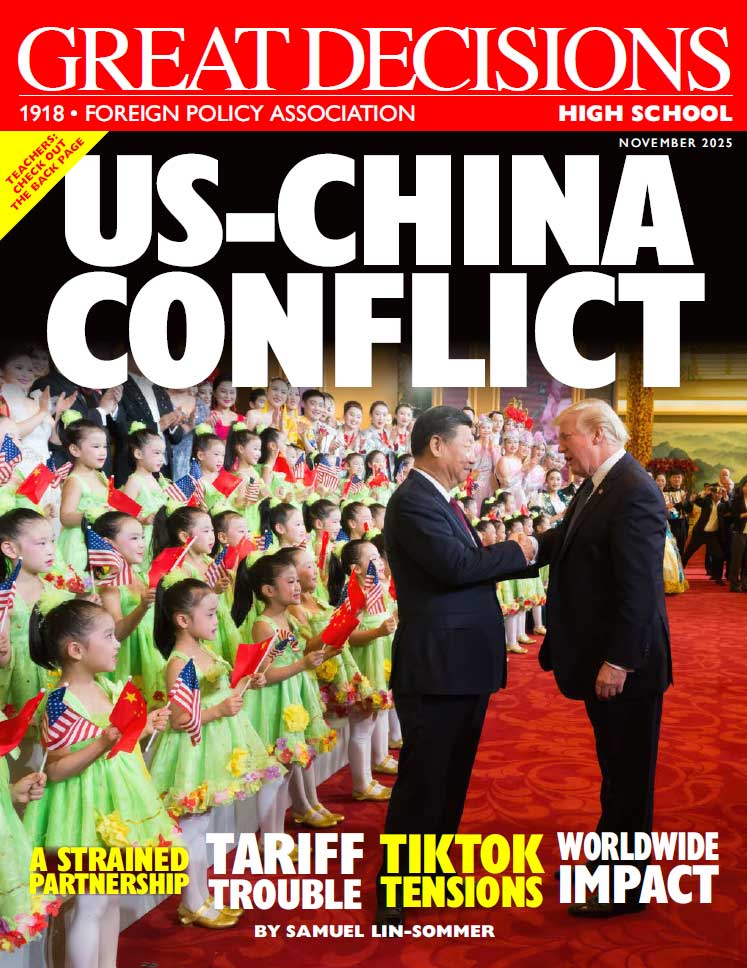
U.S.–China Relations: Competition or Cooperation? The U.S. and China stand at the center of today’s most consequential global relationship—one that shapes trade, technology, security, and the future of international leadership.Great Decisions: U.S.–China Relations, a free classroom resource from the Foreign Policy Association, helps students explore the history, tensions, and interdependence between these two nations through […]

Dive into the essential topics shaping our world with Great Decisions 2025 E-book editions! Whether you’re seeking to stay ahead in international trends or join engaging debates, Great Decisions 2025 is your passport to understanding. Find your preferred e-book format and retailer below to get started: Barnes and Noble – Read on your Nook or any compatible device.Kobo – For […]

