
Syria is deteriorating before the world’s eyes. What is being done to stop this?
At the U.N., a new crisis appeal entitled “Enough” features the heads of U.N. humanitarian agencies appealing for support in alleviating the humanitarian situation in the country and imploring an end to the diplomatic standoff that is fuelling the violence. The video comes after these same U.N. agency heads again briefed a divided U.N. Security Council, in what has become a monthly agenda item. Human Rights Watch also released a new report last week, aptly titled “Death from the Skies,” demonstrating how the Assad regime is explicitly targeting civilians with aircraft. PBS has followed with a similarly damning documentary shot in the country, which brings to life the realities of the ongoing civil war.
However, U.N. humanitarian agencies remain at the mercy of the member states that fund them. While these same member states remain divided on what actions to take to bring the fighting to an end, the conflict itself has now reached the diplomatic headquarters of the United Nations in New York and is forcing the member states’ hand. The National Coalition for Syrian Revolutionary and Opposition Forces (NCSROF), recognized as the legitimate representative of the Syrian people by a growing number of governments, will now open an office and seek the seat as the legitimate representative of the Syrian people.
There is a lack of international consensus on recognition, however. Recent NCSROF President Moaz Al-Khatib has resigned after his proposal that the opposition could negotiate with the Assad government was rejected by the NCSROF, deciding instead that future initiatives from their organization be unanimous among its 70 members. Interim President Ghassan Hitto has also faced mounting pressures and dissent within the coalition. Ongoing concerns over the fractured nature of the opposition continue to hobble the call for support from a reluctant international community.
With fighting and diplomatic wrangling ongoing, the humanitarian situation on the ground continues to deteriorate. This despite a United Nations Office for the Coordination of Humanitarian Affairs (OCHA) donor conference held in Kuwait in January 2013 and led to pledges of $1.5 billion to address humanitarian needs both inside and outside the country. Roughly $1 billion was pledged for the Regional Refugee Response Plan (RRP), which aims to assist those outside of Syria and in the refugee camps of neighboring countries. However, only 47 percent of the promised funds have been received to date. The remaining $500 million pledged for the Syrian Humanitarian Assistance Response Plan (SHARP) aims to assist those inside Syria, but only 62 percent has been received. While difficult questions remain over aid distribution, the possibility of the humanitarian situation spreading and destabilizing neighboring countries is rapidly increasing.
Lebanon is stretched for funds to assist with the increasing number of refugees while simultaneously trying to ensure sectarian conflict does not take hold. In Turkey, where a “Friends of Syria” meeting and the opposition yet again called for military aid, the government cannot keep up with the urgent need to house the exponential growth in refugees there. Jordan is also stretched from the increased numbers of refugees and hoping for the creation of safe-zones, while fearing violence could spread to its borders and threaten its frail government. Iraq fears the same. The Assad government has repeatedly denied urgent calls for cross-border humanitarian intervention to ease the suffering of those in remote areas, as well as inspectors to investigate alleged use of chemical weapons.
It is in this context that a draft resolution is having its language haggled over in the diplomatic missions of Turtle Bay. There is speculation that the latest draft will contain a paragraph calling for the opposition to assume the Syrian seat at the U.N. until elections are held in Syria. Beyond lingering doubts over the internal cohesion of the opposition, a call for overt support for the opposition undermines the U.N.’s stated Geneva communiqué for a dialogue process and forces reluctant member states to pick sides and the paragraph on recognition proceeds remains up for debate. With overt external intervention unlikely, the opposition and its Arab allies are seem willing to provoke a response to galvanize a still-hesitant international community.
Less contentious has been the proposed paragraph seeking the High Commissioner for Refugees (UNHCR) recommendation on confronting the humanitarian suffering. With fighting and diplomatic gridlock ongoing, the UNHCR will ostensibly reiterate calls for a humanitarian “safe zone,” arguably a euphemism for a no-fly zone or humanitarian corridor. The aim of this safe zone would be to protect Syrian’s fleeing the fighting and permit them to receive humanitarian aid without a fear of violence while easing the influx of refugees into neighboring countries.
The “safe-zone,” however, would still necessitate the unanimous Security Council vote of its 15 members that has so far failed to materialize. So long as the Security Council stands in firm standoff along great-power self-interest and real politic there can be little prospect of ending the fight through the U.N. system. The sensitivity surrounding military intervention has especially divided the five veto wielding permanent members of the Security Council, pitting the U.S., U.K. and France against Russia and China, who have thrice wielded their vetoes on Syria. Despite the mounting humanitarian crisis, there is little to suggest this will change.
Briefing the Security Council a day after the heads of the U.N. agencies, joint U.N.-Arab League Envoy Lakhdar Brahimi expressed his ongoing frustration at the stalemate in and apologized for his lack of progress what was described as an unusually “grim” closed door consultation. He also expressed frustration towards the League of Arab States for pushing opposition recognition to represent Syria in all the agencies of the League of Arab States system until elections are held in Syria. Brahimi was critical of the League of Arab States in saying the move compromised his neutrality, ending the Geneva push for dialogue and leaving him with no role as joint U.N.-Arab League Envoy, now that the Arab league had effectively taken sides.
As fighting rages on in stalemate, mirroring diplomatic efforts, the humanitarian situation can only get worse.
To date, an estimated 6.8 million Syrians are in need of aid, 4.3 million are internally displace, 3.1 million are registered as refugees in neighboring countries and 70,000 have been killed.
Syria continues to deteriorate before our eyes. What is being done to stop this?

Edited by G. John Ikenberry.Cover image download. Proposed Essay Topics 1) American Foreign Policy and the Future of Multilateralism Over the postwar decades, the United States played a leadership role in building multilateral regimes and institutions across a wide range of policy areas. It was a founder of the United Nations and champion of the […]
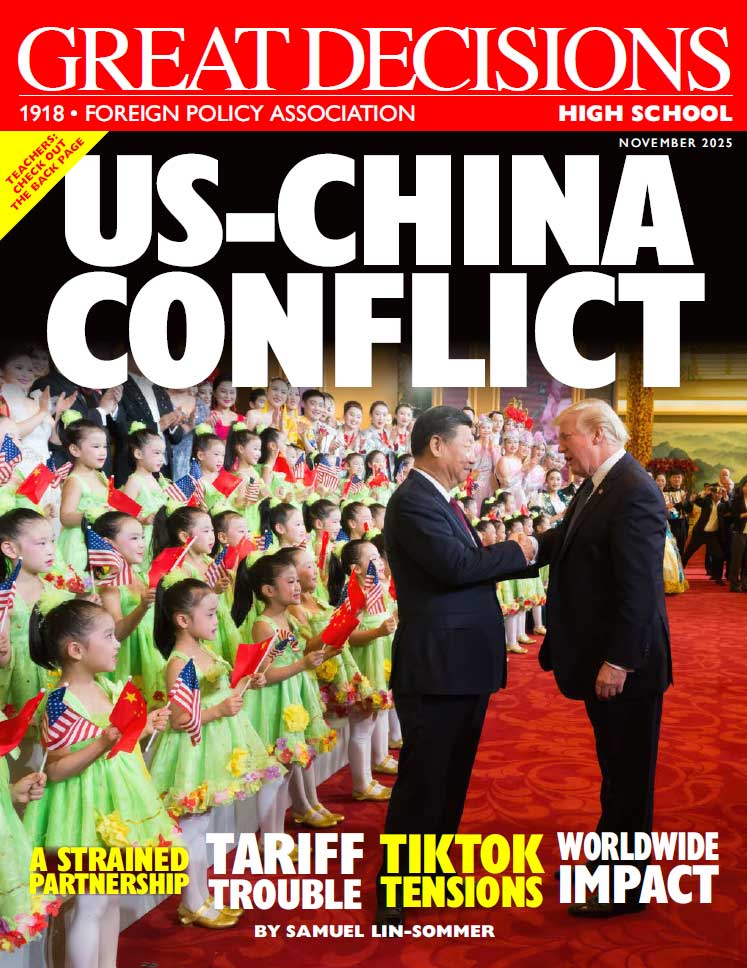
U.S.–China Relations: Competition or Cooperation? The U.S. and China stand at the center of today’s most consequential global relationship—one that shapes trade, technology, security, and the future of international leadership.Great Decisions: U.S.–China Relations, a free classroom resource from the Foreign Policy Association, helps students explore the history, tensions, and interdependence between these two nations through […]
Dive into the essential topics shaping our world with Great Decisions 2025 E-book editions! Whether you’re seeking to stay ahead in international trends or join engaging debates, Great Decisions 2025 is your passport to understanding. Find your preferred e-book format and retailer below to get started: Barnes and Noble – Read on your Nook or any compatible device.Kobo – For […]

