
{Preface: In my penultimate post I discussed the trends that may allow Argentina and Chile to upend the region’s longstanding natural resource curse. I then pointed to one notable exception—Bolivia. In response to that piece I received a very pithy comment from Roque Planas, an editor at Latin Dispatch. My aim in this post is to address Roque’s comment in light of an essay published in the March 22nd edition of the New Yorker. Several of the quotes cited here originally appeared in that article.}
Bolivia is in a tough spot. Landlocked among the oxygen slight crests of the Andes, the nation has historically strained ties with its neighbor Chile, which seized a strip of Pacific frontage it possessed over a century ago. This was the chief result of the War of the Pacific. The chief cause of the war: competing claims over mineral rights in the disputed territory.
It wasn’t the first time Bolivia was singed by claims over natural resources. When silver was discovered in the peaks overlooking the town of Potosí, in what came to be called ‘Cerro Rico’–“hill of riches”–in 1544, the Spanish set about extracting the silver with utter contempt for local welfare.
Cerro Rico spelled cero rico for nearly all Bolivians, though it engendered a small sect of local elites. For the next four centuries elites battled over control of the country’s natural resources, leaving Bolivia poor and underdeveloped. Foreign investors were often co-opted by one group or another, giving life to the time-tested process of predation whereby a small cabal brings in foreigners to extract a resource in return for splitting the largesse. Today when Bolivians cry of a “natural resource curse,” they have good reason.
Fear of a new wave of foreign exploitation has increased in recent years. This time though the resource in question is not silver, gas, or oil. It’s lithium.
Lithium battery technology will play a critical role in any move toward energy conservation that takes place in the coming years. All current model hybrid cars use lithium batteries, and the next generation of electric hybrids will too. Says one Ford exec, “We don’t think about electric vehicles using anything else.”
Hence, 2003-2007 saw global demand for lithium carbonate double, and that may only be the beginning. With the number of new hybrid models expected to be unveiled, along with government-sponsored green initiatives like the one proffered by President Obama, the world market for lithium-ion batteries may swell 14 fold from 2009-2030, according to a report by Credit Suisse (pdf.).
Bolivia could gain handsomely from increased demand for lithium; its salt flats contain over half of the world’s known lithium reserves, by conservative estimates, crowning it “the Saudi Arabia of lithium.” Such prodigious reserves should make Bolivia a price-setter in the industry, choosing who will recover its lithium and on what terms. But this isn’t the case.
Barriers to Investment
Shortly after riding a wave of indigenous populism to office in 2005, President Evo Morales made good on his pledge to chasten “exploitative capitalism.” He quickly moved to expand state’s role in the economy, nationalizing the oil and gas industries. Seeing lithium as a resource with the power to transform Bolivia into a modern society, Morales vowed, “The state will never lose sovereignty when it comes to lithium.” Comibol, the state agency that oversees mining projects, is putting that view into action. Last year Comibols’ director, Saul Villegas, described the Morales plan for lithium mining as an end to “the previous imperialist model,” one that may eventually entertain foreigners as clients, to be supplied with no middlemen.
A less salient feature of the “Morales factor” is revanchism. On March 23, Morales headed Bolivia’s Sea Day Celebration, commemorating the end of War of the Pacific, which resulted in Chile annexing half of Bolivia, including its Pacific coast. The fete’s recently adopted slogan—“Motherland or Death: We Shall Overcome”—is but one reminder that Bolivians are still smarting from their territorial losses.
Ignoring such sentiment can be hard in Bolivia, as President Gonzalo ‘Goni’ Sánchez de Lozado discovered in 2003. To cover budget shortfalls he initiated natural gas sales to the US and Mexico, via Chilean ports. The public rage, which perceived capitulation to Chile, led to widespread rioting, which eventually drove Goni—and his interim successor—to resign. Morales’ tenure has coincided with growing calls for Bolivia to regain a Pacific coast, and while brooking such sentiment may be a matter of political survival in Bolivia, it raises eyebrows in Santiago, adding to La Paz’s isolation.
If Bolivia’s political landscape is unstable, the physical landscape is daunting. Beyond being landlocked, most roads are steep and unpaved, making commercial trucking two-three times as expensive in Bolivia as in neighboring countries. Additionally, most workers are unskilled, and many don’t know Spanish. Amassing the infrastructure so Bolivia can reliably export lithium would cost about $600 million, roughly the size of the worldwide lithium market, a sad testament to Parag Khanna’s thesis, “Independence without infrastructure is futile.”
Enter the Runners-Up
Chile became the world’s largest exporter of lithium over a decade ago, owing to its large lithium deposits, as well as the sophisticated trade ties of firms like the Chemical & Mining Company of Chile, which exports to more than 100 countries. Argentina has become a force more recently. In January, Ford and Toyota announced separate ventures amounting to more than $110 million. Before these investments begin operation several other promising sites, such as a mine in Jujuy Province, are sure to swell Argentina’s presence in the global lithium market. Industry scuttlebutt has it that Argentina will surpass Chile as the world’s largest lithium exporter by 2012.
Meanwhile, the window to cash in on lithium is narrowing as the amount of the element recovered paces market demand. Though lithium is often likened to oil, ion batteries are long lasting, and relatively small amounts of lithium are needed per unit. Chevy’s new Volt, for instance, has a gargantuan battery pack that weighs almost 400 pounds, but manufacturing it requires less than 4 pounds of lithium.
A final wild card likely to affect the long-term demand for lithium is recycling, which may greatly dampen the need for new supplies.
A Curse By Other Means
Believing their prodigious reserves will remain in demand long into the future, Bolivian policymakers have signaled their intent to harvest lithium according to the government’s “own timetable” in order to ensure the state retains utmost control. Currently only one small-scale lithium recovery project (funding estimates range from $5.7-8 million) is under way.
Weighing the political and logistical barriers, many business projections now discount Bolivia altogether. GM’s Global Energy Systems counts on Argentina and Chile for cheap lithium till 2060, and the CEO of mining giant Orocobre considers Bolivia “a seductress” that ultimately “doesn’t work.”
By not engaging foreign enterprise Bolivia stands to fall victim to a different curse: prideful overreaction to past wounds.
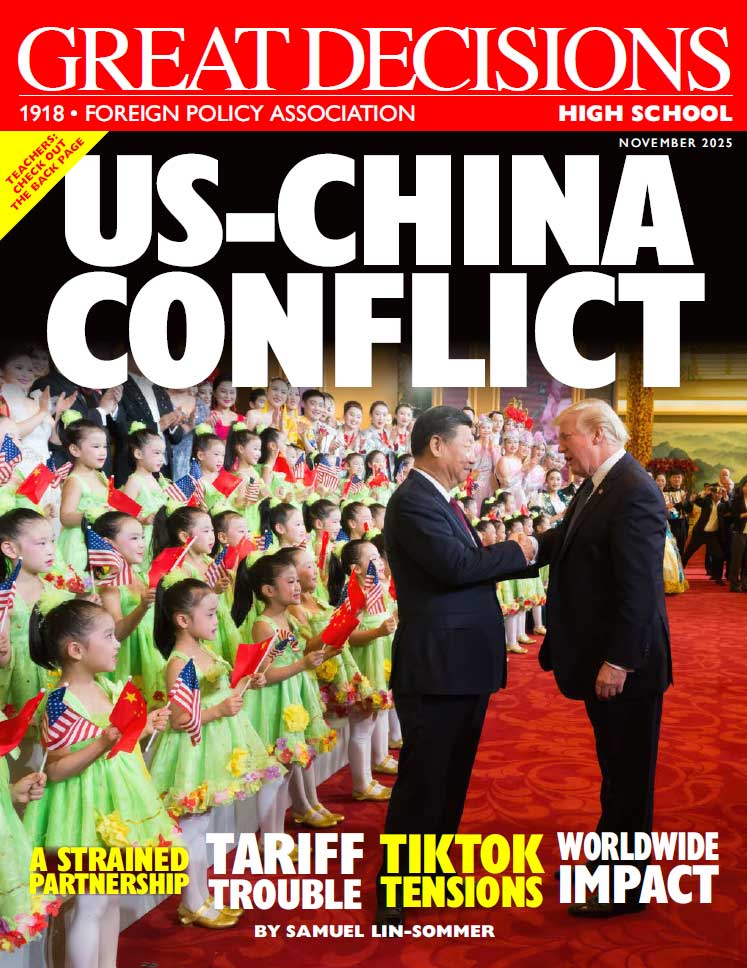
U.S.–China Relations: Competition or Cooperation? The U.S. and China stand at the center of today’s most consequential global relationship—one that shapes trade, technology, security, and the future of international leadership.Great Decisions: U.S.–China Relations, a free classroom resource from the Foreign Policy Association, helps students explore the history, tensions, and interdependence between these two nations through […]

Dive into the essential topics shaping our world with Great Decisions 2025 E-book editions! Whether you’re seeking to stay ahead in international trends or join engaging debates, Great Decisions 2025 is your passport to understanding. Find your preferred e-book format and retailer below to get started: Barnes and Noble – Read on your Nook or any compatible device.Kobo – For […]

