
This past week was characterised by one major international news story and one minor one. The European Union and Canada gave notice to Iranian officials this week of their support for sanctions against Iran because its nuclear program. Canada was making a point of sounding off with the EU possibly due to Iran’s ironic and insulting diplomatic criticism of Canada’s handling of G20 protests in Toronto as violating protestor’s rights to free speech. The latter story was that of divided ties between Colombia and Venezuela due to noted accusations by President Chavez that Colombia and the US wished to assassinate him and Colombian accusations that Chavez was supporting rebels inside Colombia. Chavez’s accusation of his imminent assassination has been a consistent complaint lodged by Chavez. Colombia and President Uribe have made a point of aggressively fighting rebels in Colombia and issuing evidence that Chavez and Venezuela have been coordinating with rebels inside Colombia to destabilise the Andean nation.
Evidence presented by Colombia came about in an OAS meeting on July 22nd and were addressed in a Unasur meeting July 29th showing that 1500 rebels from the ELN and FARC were working inside and supported by Venezuela. Accusations of starting a possible conflict at the end of Uribe’s term in office were focused on by Venezuelan officials as a last violent act by Uribe, but Colombia’s support for their President and the old Defence Minister and new President, Juan Manuel Santos will likely solidify a continuation of Colombia’s and Venezuela’s Cold Peace for years to come. Santos will take office in a few days time, but has worked as the Defence Minister under President Uribe during many diplomatic trials with Venezuela in the past. Since Colombia’s incursion into Ecuador in 2008 and the declaration of placing US bases inside Colombia in 2009, Uribe and Santos have suffered diplomatic troubles with Chavez and leftists in the region. In all cases, no hot conflict or shots were ever fired officially between the two states or their armies and border crossings and trade have remained relatively steady and healthy, even with oil exports continuing into the US and Chavez meeting President Obama on one occasion. With accusations by Venezuela that electing Santos would lead to war, and continued information presented by Colombia of Venezuela’s tangible support for narco-rebels inside Colombia, the pillars of trade and relations have always remained strong between the two countries. In this latest round, the new President of Colombia and accusations of continued support for the FARC and ELN at the OAS lead to Venezuela breaking relations, again, but also claiming a reduction or halt to oil exports to the US and blocking trade between Venezuela and Colombia, an action that would likely hurt both countries considerably.
Apart from Venezuela’s relations with its neighbour, the context of the larger international story should be considered. A small point to start off with it that Venezuela’s oil exports, while substantial to the US, could be supplemented by Canadian oil and allow Canada’s oil producers to justify the environmental costs in order to supply the US with local and secured oil that are not tied to a possible hot conflict in South America. Venezuela’s growing relations with Iran might also bring some attention from the Middle East into South America, but negative attention is not always the best way to gain support for social change within a country, and positive attention by Oliver Stone might do Chavez better than supporting Iran’s treatment of its protestors while trying to solidify his own popular revolution. It is a certainty that many Venezuelans benefit from investments into health care and social services under Chavez, but if the social revolution in Venezuela is about those individuals, closing off trade and pushing a local movement into an international debate where the US is willing to commit active military forces might not be beneficial to anyone in South America. With the end of Uribe, also comes the end of Lula in Brazil and elections in October in the burgeoning BRIC, and it will be seen if the PT party in Brazil’s next election can maintain their support for Chavez and political manoeuvring with Iranian issues and still benefit from ties to the US and EU. Most experts see a move to the centre right in Brazil and a direct move away from Lula’s latest international activism in the process. So far, relations between Venezuela and Colombia could best be described as a Cold Peace, but if accusations and actual economic losses, or skirmishes between official military forces result out of this latest debate, it could easily lead to a Hot War in the Andean region, a conflict that no one wants or is likely willing to give their lives for.

Edited by G. John Ikenberry. Proposed Essay Topics 1) American Foreign Policy and the Future of Multilateralism Over the postwar decades, the United States played a leadership role in building multilateral regimes and institutions across a wide range of policy areas. It was a founder of the United Nations and champion of the Bretton Woods […]
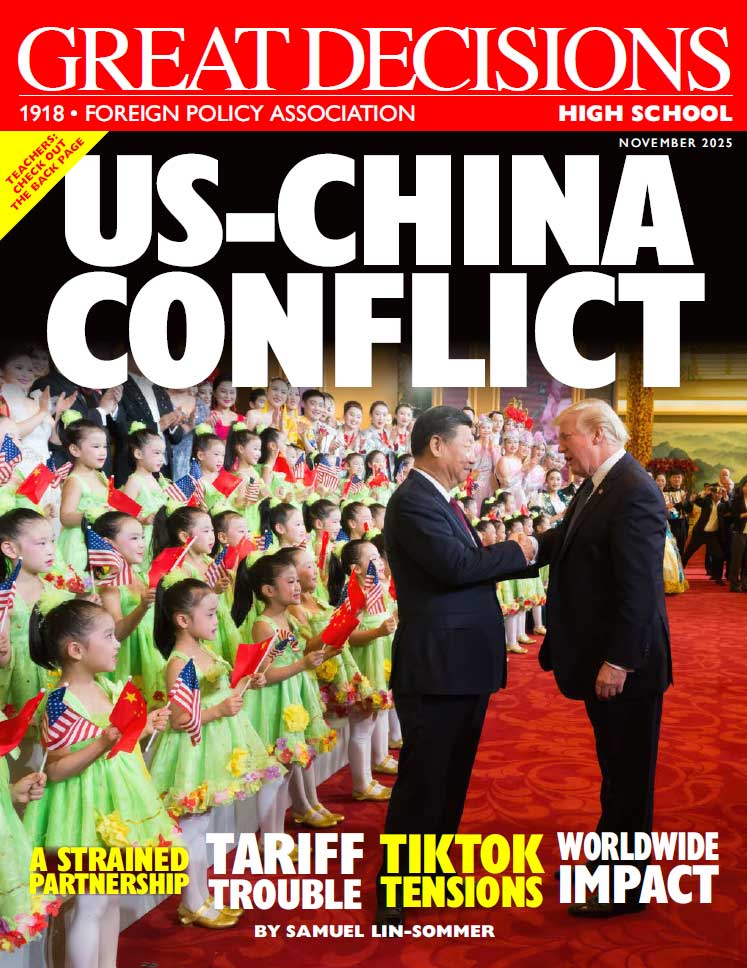
U.S.–China Relations: Competition or Cooperation? The U.S. and China stand at the center of today’s most consequential global relationship—one that shapes trade, technology, security, and the future of international leadership.Great Decisions: U.S.–China Relations, a free classroom resource from the Foreign Policy Association, helps students explore the history, tensions, and interdependence between these two nations through […]
Dive into the essential topics shaping our world with Great Decisions 2025 E-book editions! Whether you’re seeking to stay ahead in international trends or join engaging debates, Great Decisions 2025 is your passport to understanding. Find your preferred e-book format and retailer below to get started: Barnes and Noble – Read on your Nook or any compatible device.Kobo – For […]

