
I recently had the privilege of meeting with a Cuban official to exchange thoughts on U.S.-Cuban relations. I took note in particular of the following points he made:
—The official said he was pleased by the recent progress between Cuba and the United States, especially with respect to the bilateral migration discussions that took place in NYC in July (and will likely continue with another round in Havana in December or January, he said), and to President Obama’s April promises to ease restrictions on travel by and remittances from Cuban-Americans. But even the migration talks were not new; they were a necessity that had been paused for five years under the George W. Bush administration. And President Obama’s promises took five months to materialize—why so long?
—He expressed frustration that the Ley de Ajuste (the Cuban-Adjustment Act) was not on the table in the bilateral migration conversations, when this was one of the most important migration issues from the Cuban perspective. Under it, Cubans are treated differently than any other migrant to the United States; there is no cap on the number of Cubans that can be naturalized in a given year, and Cubans are not required to enter the United States at a port-of-entry. Coupled with the wet foot-dry foot policy, the Cuban Government considers this a deadly law.
—He also stood firmly behind the official statements from Cuba on the issue of discussions “without preconditions.” Creating preconditions—i.e. necessary steps that Cuba must take before the United States is willing to even speak directly—means, in his view, that the United States already does not consider the nations to be speaking igual a igual. There is no Cuban official that is not willing to speak to the United States, he said. And Raúl has indeed stated multiple times that Havana is ready to talk to Washington about anything. But Cuba wants to be treated as an equal in such discussions, because as an independent nation it is an equal, and will not settle for less.
—The official I spoke to strongly favored easing of travel restrictions to allow US citizens to visit Cuba, which he said was important for dispelling myths that Americans may have incorporated into their understanding of the country. Americans must see el Cuba real, he argued, so they can see that it is not a country of poor citizens crushed under the thumb of dictatorship.
—Importantly, he conceded that the country is not perfect by a long shot. A country under great pressure, he noted, cannot be perfect, and indeed cannot be normal and cannot afford to have every decision approved by all parties.
This was a rare chance for me to hear these perspectives first-hand, instead of attempting to interpret them through Cuban and U.S. news outlets.

Edited by G. John Ikenberry. Proposed Essay Topics 1) American Foreign Policy and the Future of Multilateralism Over the postwar decades, the United States played a leadership role in building multilateral regimes and institutions across a wide range of policy areas. It was a founder of the United Nations and champion of the Bretton Woods […]
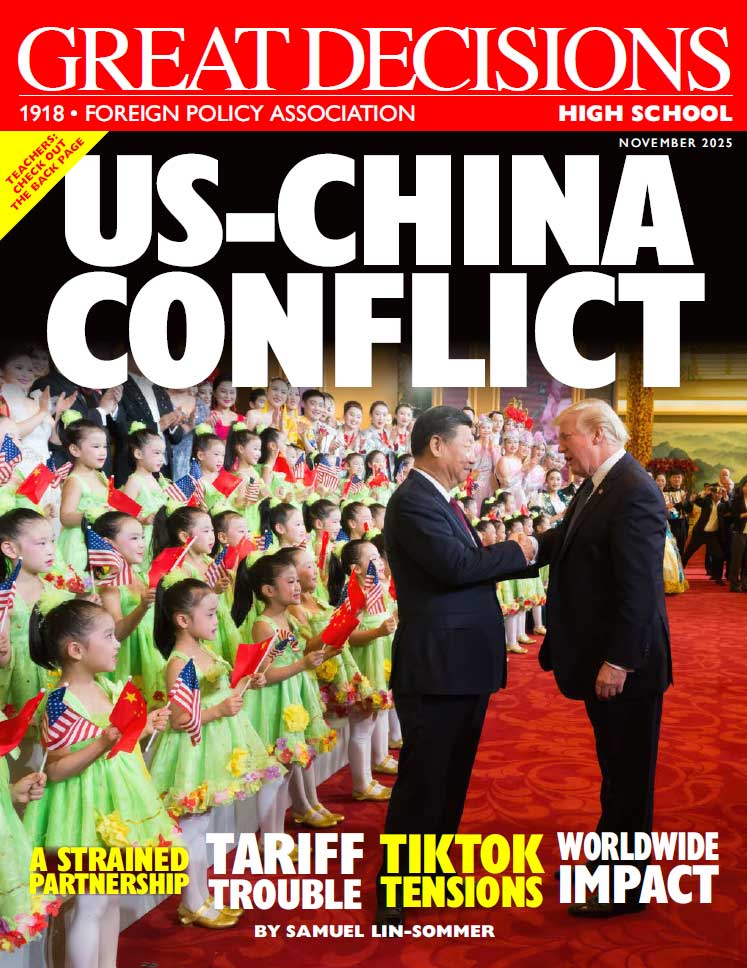
U.S.–China Relations: Competition or Cooperation? The U.S. and China stand at the center of today’s most consequential global relationship—one that shapes trade, technology, security, and the future of international leadership.Great Decisions: U.S.–China Relations, a free classroom resource from the Foreign Policy Association, helps students explore the history, tensions, and interdependence between these two nations through […]
Dive into the essential topics shaping our world with Great Decisions 2025 E-book editions! Whether you’re seeking to stay ahead in international trends or join engaging debates, Great Decisions 2025 is your passport to understanding. Find your preferred e-book format and retailer below to get started: Barnes and Noble – Read on your Nook or any compatible device.Kobo – For […]

