Foreign Policy Association
Browse Groups
  • About
  • Bookstore
  • Events
  • Great Decisions
  • Membership
  • Donate
Home Topics Defense & Security Arms Control and Proliferation

North Korean Moratorium

By: William Sweet
Note: This post reflects the views of the author, not those of the Foreign Policy Association. The author is an independent contributor.

Kim Jong-un. Korean Central News Agency, via Agence France-Presse, Getty Images

The startling agreement announced today–the U.S. providing North Korea food aid in exchange for the North’s putting a moratorium on uranium enrichment, nuclear weapons tests and long-range missile testing–would seem by any reckoning a very positive step in the right direction. The mere fact that North Korea’s new leadership is putting the immediately nutritional needs of the country’s population ahead of its military ambitions is in itself a good sign. So too is its acceptance of quite stringent conditions–not only the return of IAEA inspectors but monitoring of food deliveries as well, to make sure they are reaching their intended beneficiaries.

I have little to add to what’s being said on both sides of the question of how much hope to invest in the agreement. The PBS News Hour carried an excellent discussion of the North Korean agreement this evening (Tuesday night) featuring former U.S. ambassador to North Korea Donald Gregg and Balbina Hwang of Georgetown University. Hwang took the cautionary position, noting that the agreement does not even quite get us back to where we were when six-party talks were suspended in 2008. She worried that there is no mention of plutonium in the statements the two parties to the agreement issued, though so far North Korea’s bombs have been made with plutonium not uranium, and she was concerned about the absence of any mention of inter-Korean relations. Gregg urged her and others to look forward rather than backward. He clearly sees the agreement as quite a big deal.

So too does Bruce Cumings of the University of Chicago. In an interview with The Hindu, Cumings says that “the moratorium on nuclear and long-range missile tests is very important, because Washington wants to stop the North from working on a miniaturised nuclear weapon that could become a missile warhead.”

Related Articles from this category

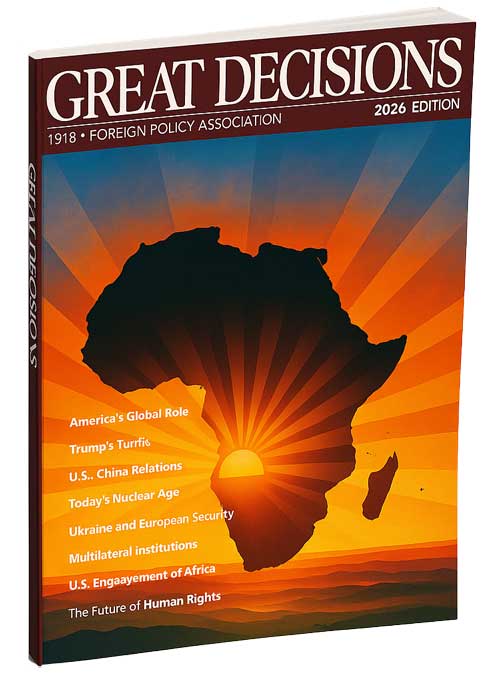
Great Decisions 2026
  • Topics
Great Decisions 2026 Topic announcement
September 3, 2025 2 min. read
Read more
  • International
  • Topics
The Missing Pillar
April 10, 2024 6 min. read
Tags: Canada, Cuba, Embargo, Haiti, United States, Venezuela
Read more
  • International
  • Topics
Tanks and the Invincibility Myth
April 3, 2024 4 min. read
Tags: Abrams, Leopard 2, NATO, Russia, tanks, Ukraine
Read more
  • International
  • Topics
In Waiting for the Great Displacement
March 8, 2024 7 min. read
Tags: China, human rights, Iran, Middle East, Russia, Ukraine, United States, WAR
Read more
  • International
  • Topics
After the Eleventh Hour
February 29, 2024 5 min. read
Tags: development, Japan, peace, WAR
Read more
  • International
  • Topics
Departing the Red Sea
February 7, 2024 3 min. read
Tags: China, Houthis, India, Iran, Middle East, missiles, Russia, shipping
Read more
  • International
  • Topics
The Modernisation of Old Artillery
January 30, 2024 6 min. read
Tags: A-50, Artillery, IL-22, missiles, radar, Russia, Ukraine
Read more
  • International
  • Topics
Accessory to Casus Belli
January 16, 2024 5 min. read
Tags: AI, Casus Belli, corruption, international law, laundering, missile defence, missiles
Read more

Sign up for updates!

Get news from Foreign Policy Association in your inbox.

  • Events
  • Upcoming Events
  • Past Events
  • Event Video
  • Great Decisions
  • Topic Resources
  • Materials
  • Groups
  • Membership
  • About
  • Become a Member
  • Manage Profile
  • Contact Membership
  • About
  • Mission
  • History
  • Press
  • Contact
  • Privacy Policy
© 2026 Foreign Policy Association